AI video looks a lot more usable in 2026. Leading models now focus on better motion, stronger scene consistency, and more control. Runway’s recent materials for Gen-4 and Gen-4.5 highlight improvements in motion quality, prompt adherence, visual fidelity, and consistency across scenes.
That matters because AI video is now useful for ad creatives, product demos, media workflows, and app features. The harder part is that the market moves fast and the model landscape is fragmented. That is why a unified layer like LLMAPI can be useful: one API setup is easier to maintain than rebuilding around each new video model.
The major AI video models that matter in 2026
The market is crowded, but a few names clearly lead it. The easiest way to compare them is by asking four questions: What does it do well? Who is it for? How do you use it? What are the trade-offs?
Kling AI 3.0
Kling is one of the strongest all-around options right now, especially when you care about motion realism, longer clips, and story-style output. Its own developer materials highlight up to 15-second generation, scene cuts, storyboard-style control, and ultra-high-definition output. Third-party testing and reviews also keep pointing to its strong handling of gravity, balance, fabric, and action-heavy motion.
Main features:
- Physics-aware motion.
- Up to 15-second clips.
- Smart storyboard / Multi-shot workflows.
- Native audio-visual sync.
- Ultra-hd output options.
- Strong scene continuity tools.
Best for:
- Cinematic short videos.
- Action scenes.
- Branded story clips.
- Social ads that need more movement and drama.
- Teams that want one model for both spectacle and consistency.
How to use it
Start with a short storyboard, not one giant prompt. Define the subject, action, camera feel, and mood first. Then add reference images or scene notes if you want stronger continuity across shots. Kling tends to reward clearer direction when the scene is busy.
| Pros | Cons |
| Strong motion realism | More moving parts in setup |
| Longer clip length | Can be overkill for simple clips |
| Good multi-shot storytelling | API workflows can get messy if you want polished automation |
| Native audio support | |
| High-resolution output options |
Google Veo
Veo is one of the strongest choices for polished, premium-looking output. Google positions Veo 3 around native audio, strong prompt adherence, realism, and physics. Vertex AI also lists multiple Veo variants, including Veo 3, Veo 3 Fast, and Veo 3.1 Lite, which makes it easier to choose between quality and speed.
Main features:
- Native dialogue, sound effects, and ambient audio.
- Strong prompt adherence.
- Realistic lighting and depth.
- Image-to-video support.
- Reference-based consistency features.
- Multiple speed/Quality tiers on vertex AI.
Best for:
- Marketing visuals.
- Polished commercial-style output.
- Product videos.
- Brand teams that care about atmosphere and clean results.
- Users who want audio and visuals generated together.
How to use it
Use Veo when the shot needs to feel premium and controlled. Write prompts like a director: subject, environment, lighting, movement, and sound. If consistency matters, use reference images and keep each shot focused instead of trying to force too many scene changes into one request.
| Pros | Cons |
| Native audio generation | Can be slower on premium generations |
| Strong cinematic quality | Best experience often ties into Google’s ecosystem |
| Excellent prompt adherence | Not always the cheapest option for high volume |
| Good image-to-video tools | |
| Multiple model tiers for cost/speed |
Runway Gen-4.5 / Gen-4
Runway stays very strong when you want more control. Its current materials focus on visual fidelity, prompt adherence, creative control, and consistent characters, objects, and locations across scenes. Motion Brush and camera-direction workflows remain part of why creative teams like it so much.
Main features:
- Strong creative control.
- Consistent characters and objects.
- Motion brush for directing movement.
- Camera movement guidance.
- High-end cinematic styling.
- Production-friendly creative workflows.
Best for:
- Agencies.
- Editors.
- Design teams.
- Image-to-video workflows.
- Campaigns where users want to direct the look more precisely.
How to use it
Runway works best when you already know the look you want. Start with a reference image or very visual prompt, then use motion and camera cues to shape the shot. This is a strong pick when the creative team wants hands-on control instead of “type prompt and hope.”
| Pros | Cons |
| Strong creative control | More manual direction needed |
| Good consistency tools | Can take longer to master |
| Motion Brush is useful | Better for crafted output than fast bulk generation |
| Great for image-to-video work | |
| Popular with professional creative teams |
OpenAI Sora 2 / Sora 2 Pro
Sora still matters because of its world-building, motion quality, and longer-form ambition. OpenAI says Sora can generate videos up to a minute long while keeping visual quality and prompt adherence. The API pricing page lists per-second video pricing, which makes cost planning easier than vague credit systems. One important current detail: OpenAI’s docs now say the Sora 2 video generation API is deprecated and will shut down on September 24, 2026.
Main features:
- Long-form text-to-video generation.
- Strong world and scene understanding.
- High-quality motion and cinematic framing.
- Resolution-based API pricing.
- Suitable for ambitious concept clips and story scenes.
Best for:
- Teams testing premium narrative output.
- High-concept brand storytelling.
- Cinematic concept work.
- Projects where longer generated clips matter more than low cost.
How to use it
Use Sora for bigger, more cinematic scenes that need room to unfold. Keep the prompt structured: environment, action, camera, timing, and visual style. But go in with your eyes open: if you are building a long-term workflow, the announced deprecation means you should avoid locking your whole strategy to Sora alone.
| Pros | Cons |
| Longer video potential | Expensive at higher settings |
| Strong scene/world understanding | API is already marked for deprecation |
| Good cinematic camera feel | Risky as a long-term single-model bet |
| Clear pricing per second | |
| Strong brand recognition |
Wan 2.7 and Vidu Q3
These are worth grouping together because they are both strong when you need speed, cost control, and practical output, not just headline demos. Wan 2.7 is getting attention for editing, first-and-last-frame control, subject referencing, and natural-language video changes. Vidu Q3 stands out for 16-second clips, native audio-video generation, and precise camera control.
Main features:
- Wan 2.7: first/last frame control, video editing, subject reference.
- Vidu Q3: native audio-video output, 16-second clips, camera control, multi-shot storytelling.
- Both are useful for faster, more scalable content workflows.
Best for:
- Social content teams.
- Fast campaign testing.
- High-volume content creation.
- Budget-aware teams.
- Users who need workable output fast rather than “perfect studio” output.
How to use them
Use Wan when you need to revise or reshape existing shots more flexibly. Use Vidu when you want finished clips with audio already baked in. These models make the most sense when speed and repeatable throughput matter a lot.
| Pros | Cons |
| Better for faster turnaround | Less prestige than the biggest flagship names |
| More budget-friendly positioning | Quality can vary more by use case |
| Useful editing/control features | Fewer teams already have established workflows around them |
| Vidu supports native audio-video output | |
| Good fit for scaled content production |
Quick comparison table
| Model | Best at | Best for | Biggest caution |
| Kling AI 3.0 | Motion realism and story-style clips | cinematic social, action, branded stories | setup can get more complex |
| Google Veo | Premium visual polish + native audio | commercials, premium marketing, product visuals | slower and often pricier |
| Runway | Fine creative control | agencies, editors, brand teams | takes more hands-on direction |
| Sora 2 | Longer cinematic generation | concept videos, premium storytelling | API is deprecated for Sep. 24, 2026 |
| Wan 2.7 / Vidu Q3 | Speed and scalable output | high-volume content, faster teams, budget-conscious users | not always the strongest for premium cinematic polish |
Why direct video API integration gets messy fast
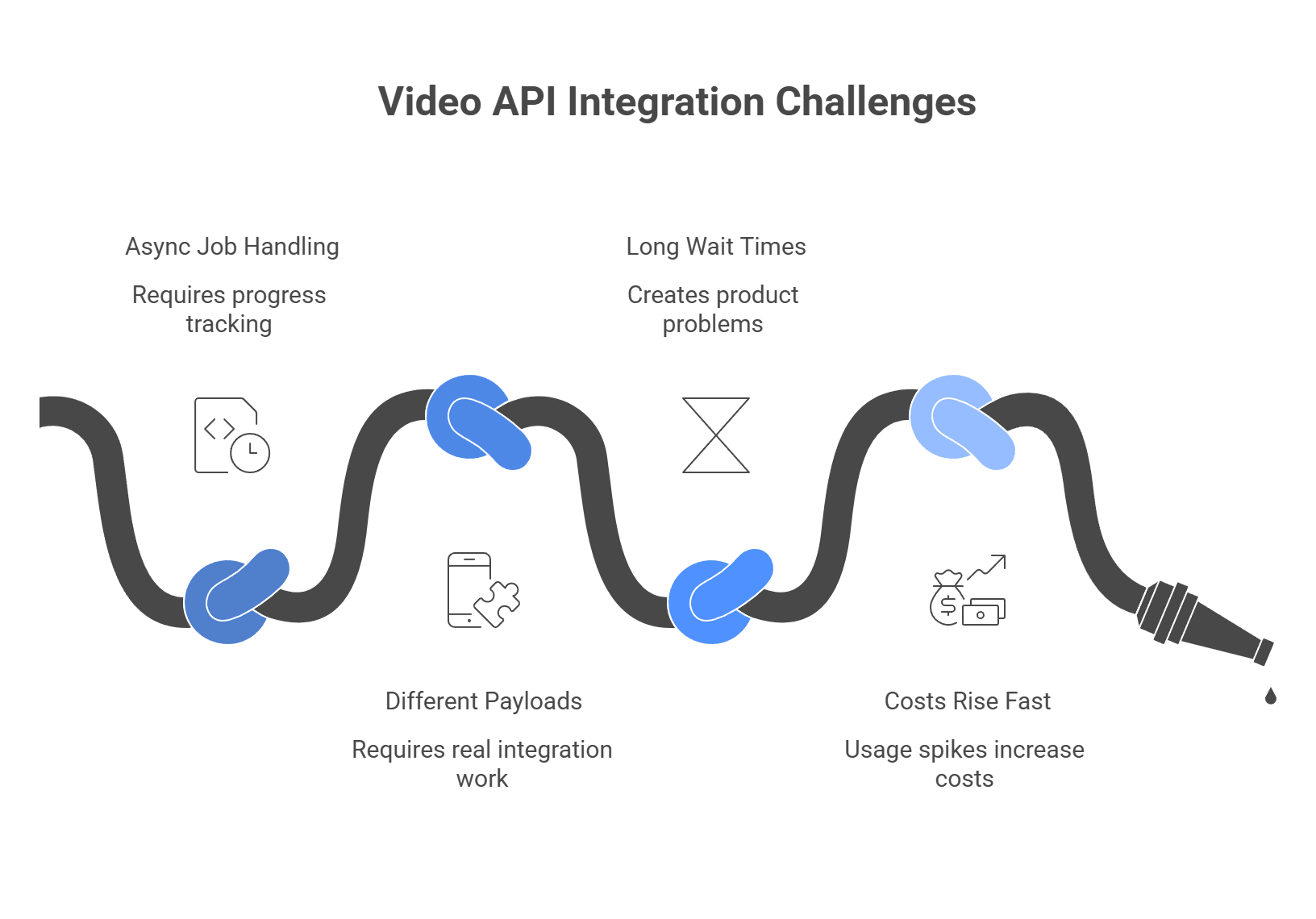
The models are impressive. The integration work usually is not. Video APIs behave very differently from text models. In many cases, you do not send a prompt and get a result back right away. You submit a job, get a task ID, then wait while the provider renders the video. That means extra work around polling, retries, status checks, and failed jobs.
Here are the biggest pain points:
- Async job handling. Video generation usually runs as a background job, so your app has to track progress and know when the file is ready.
- Different payloads for every provider. Kling, Veo, Runway, and others all use different request formats, parameters, and output structures. Switching providers often means real integration work, not a quick model swap.
- Long wait times. Video takes longer to generate, especially during heavy traffic. That creates product problems too: loading states, abandoned sessions, retries, and user frustration.
- Costs can rise fast. Video generation is expensive compared to text. If usage spikes and every action triggers a premium model, costs can climb very quickly.
So yes, the model quality is exciting. But the real challenge sits in the workflow around it: job orchestration, provider differences, wait-time handling, and cost control.
Why route AI video through LLMAPI?
If you want to build an AI video app that can scale in 2026, one provider is usually not enough. Different models have different strengths, prices, wait times, and uptime. A unified API layer helps you avoid that mess and gives you more control over how your product works.
Here is why many teams use LLMAPI for video features:
A single endpoint for multiple video models
Instead of building separate integrations for Kling, Runway, and Veo, you connect to one API endpoint through LLMAPI. You prepare the prompt and image input once, then switch models by changing the “model” value in your JSON payload. LLMAPI handles the provider-specific work on its side.
One approach to async video requests
Video generation often takes time, and each provider tends to handle callbacks or status checks a bit differently. LLMAPI gives you one webhook format or one polling flow to check request status and fetch the final .mp4 output, no matter which model created the video.
Automatic failover and traffic routing
When one provider slows down or starts to return errors, your app should still work. With LLMAPI, you can route requests to another model automatically. For example, if Kling runs into 503 errors, the request can move to Veo 3.2 or Runway Gen-4.5 instead. That helps keep your video button usable and cuts down on failed requests.
Smarter cost control by user tier
Not every request needs the most expensive model. LLMAPI lets you route traffic based on your product logic. Free users can use a faster, lower-cost model like Wan 2.7, while paid users can get higher-quality output from models such as Veo 3.2 or Sora Pro. This gives you a cleaner way to match cost with customer value.
The Architecture of a Unified Video Request
Once you put an aggregator in the middle, the request flow gets much simpler. Instead of dealing with different payload formats, async patterns, and callback setups for each video provider, your app follows one consistent path from request to final file.
Unified video APIs commonly use this kind of async job flow: submit the request, get a job ID back right away, then poll for status or wait for a webhook when the render is done.
Step 1 (The request)
Your frontend sends a prompt, such as “A cinematic pan of a cyberpunk city in the rain,” plus an optional reference image, to LLMAPI’s video generation endpoint. From your side, it is one clean request format instead of a different integration for every model vendor.
Step 2 (The gateway)
LLMAPI receives the request, checks which provider is available, routes the call to the selected model or fallback model, and maps your payload to that provider’s required schema. This is one of the main reasons teams use unified AI gateways in the first place: the app talks to one API, while the gateway handles provider-specific differences behind the scenes.
Step 3 (The queue)
Because video generation is a long-running task, the request does not stay open until the file is ready. Instead, LLMAPI returns a standardized job_id right away, usually with an initial status such as pending or queued.
Your frontend can then show a loading state while the job moves through the system. This async pattern is standard for video and other heavy AI workloads because it keeps the app responsive and makes status tracking much easier.
Step 4 (The delivery)
When the provider finishes the render, LLMAPI captures the result and sends the final output back through a consistent delivery path, such as a hosted file URL and a webhook to your server. Webhooks are widely used for this because they let the platform notify your backend as soon as the job is complete, instead of forcing your app to keep checking over and over.
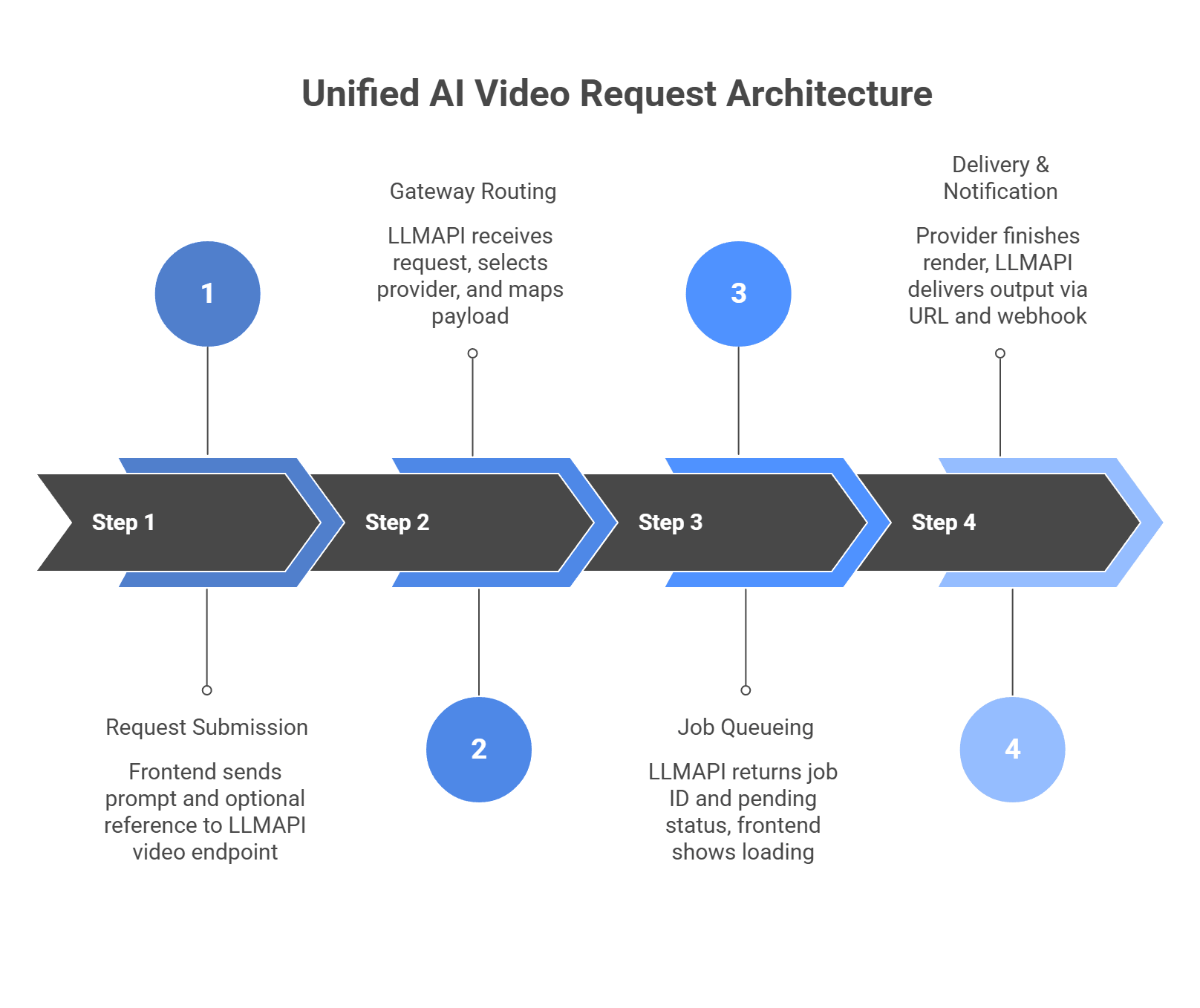
This structure is a big part of the appeal. Your team gets one request flow, one job format, and one delivery pattern, even when the actual video comes from different providers under the hood.
Ready to build AI video features without betting everything on one provider?
AI video is moving fast, and the top model today may not stay on top for long. Locking your product into one provider is a risky move when capabilities, pricing, and reliability can shift so quickly. If you want to stay competitive, your app needs room to adapt as the video ecosystem changes.
That is why flexibility matters just as much as raw model quality. A strong setup should let you explore different video tools, test what works best, and switch directions without turning every change into a full rebuild.
LLMAPI gives you a simpler way to do that. With one OpenAI-compatible API and access to 200+ models, it helps you keep your infrastructure more flexible underneath while avoiding the mess of fragmented integrations and billing. It also adds routing, fallback options, and usage visibility, which can make fast-moving AI video workflows easier to manage.
Why use LLMAPI for AI video workflows?
- One API for working across many models.
- OpenAI-compatible setup for easier integration.
- More flexibility as video models keep changing.
- Fallback and routing options for steadier performance.
- Unified usage visibility as you scale.
If you want to build AI video features without getting stuck rebuilding your stack every few months, LLMAPI is a natural layer to add. It helps you stay flexible, move faster, and spend more time building the product instead of managing provider chaos.
FAQs
How long does AI video generation via API take?
It depends on the model and quality. Fast “turbo” models can produce a ~5-second clip in under 15 seconds. High-fidelity cinematic models at 1080p/4K can take 3–8 minutes per clip.
Can AI video tools keep the same character across multiple videos?
Yes, many can. Some models support “character/element reference” modes where you pass a reference image (or a saved character ID) and the model keeps the face, outfit, and proportions consistent across scenes.
How much does AI video generation cost for developers?
Costs vary a lot. Some hosted open-source setups can be around $0.10 per second of video. Premium proprietary models can be $0.50–$1.50+ per generation, depending on duration and resolution.
How does LLMAPI simplify integrating multiple video models?
Direct integrations often have different auth methods and payload formats. With LLMAPI, you integrate once to a unified endpoint, then switch providers by changing the model name in your request.
How does LLMAPI deal with long video timeouts?
Instead of keeping one long HTTP request open, it can return a job_id right away. Then it handles the long-running generation in the background and notifies your app (or lets you poll) when the final video is ready.