
Claude Sonnet 4.6 and DeepSeek-R1-0528 are both strong AI models, but they make sense for different users.
Claude Sonnet 4.6 is the better fit for polished business work, long-context analysis, creative writing, coding agents, and teams that want a premium hosted model. DeepSeek-R1-0528 is the better fit for low-cost reasoning, open-weight experiments, self-hosting, math-heavy tasks, and developers who want more control over deployment.
So this comparison looks at the models by user group:
- Businesses
- Developers
- Creative people
- Startups and budget-sensitive teams
- Researchers and open-source AI teams
That structure matters because a finance team, a software engineer, and a content creator will judge the same model in very different ways.
A business team cares about reliability, security, long files, structured output, and how much review the answer needs. A developer cares about coding quality, API cost, tool use, context window, and deployment control. A creative user cares about voice, taste, editing quality, and how naturally the model works with rough ideas.
Quick verdict
| User group | Better first choice | Why |
| Businesses | Claude Sonnet 4.6 | Stronger long-context work, polished output, enterprise-friendly hosted access |
| Developers | Depends on workflow | Claude for agentic coding and real projects; DeepSeek for cheaper reasoning and self-hosting |
| Creative people | Claude Sonnet 4.6 | Better tone, editing, structure, and writing flow |
| Startups on a tight budget | DeepSeek-R1-0528 | Much lower token cost and open-weight flexibility |
| Researchers | DeepSeek-R1-0528 | Open weights, model inspection, self-hosting, distillation |
| Enterprise teams | Claude Sonnet 4.6 | Stronger vendor ecosystem and business workflow fit |
| AI platforms | Use both | Route premium tasks to Claude and lower-cost reasoning to DeepSeek |
If you need the short answer: choose Claude Sonnet 4.6 for quality, long context, business workflows, creative output, and production coding agents. Choose DeepSeek-R1-0528 for cost, open-weight access, research, self-hosting, and reasoning-heavy workloads.
Why we can write this comparison
Our team spends a lot of time tracking AI APIs, model releases, pricing, benchmarks, developer docs, and real workflow tradeoffs. We do not compare models only by leaderboard scores because that misses the practical part.
For this article, we reviewed:
- Anthropic’s official Claude Sonnet 4.6 launch post
- Anthropic’s Claude Sonnet 4.6 page
- Anthropic’s Claude API pricing docs
- Anthropic’s context window docs
- Anthropic’s Claude Sonnet 4.6 System Card
- DeepSeek’s official DeepSeek-R1-0528 Hugging Face model card
- DeepSeek’s official API pricing docs
- DeepSeek’s official reasoning model guide
- The DeepSeek-R1 research paper
- Reuters coverage of the DeepSeek-R1-0528 release
- Research on safety and reasoning, including RealSafe-R1 and Learning to Reason with reasoning traces
We also looked at the models through practical questions: Which one is easier to put into a product? Which one costs less at scale? Which one gives better writing? Which one gives more deployment control? Which one fits business workflows better?
What is Claude Sonnet 4.6?
Claude Sonnet 4.6 is Anthropic’s February 2026 Sonnet model. Anthropic presents it as a major upgrade for coding, agentic work, long-context reasoning, and business tasks.
The official Claude Sonnet page lists pricing from $3 per million input tokens and $15 per million output tokens, with prompt caching available for cost savings. Anthropic’s context window docs also say Claude Sonnet 4.6 supports a 1 million token context window on the Claude API, Amazon Bedrock, and Vertex AI.
| Category | Claude Sonnet 4.6 |
| Company | Anthropic |
| Release | February 2026 |
| Access | Claude API, Claude app, Amazon Bedrock, Vertex AI |
| Context window | Up to 1M tokens on supported routes |
| Pricing | $3/M input tokens, $15/M output tokens |
| Main strengths | Business writing, coding agents, long documents, polished output |
| Best for | Businesses, developers, creative teams, enterprise workflows |
Claude Sonnet 4.6 is a strong general-purpose model with a premium hosted experience. It is especially useful when the output needs to be clean, well-structured, and ready for users or teams.
What is DeepSeek-R1-0528?
DeepSeek-R1-0528 is the May 2025 update to DeepSeek’s R1 reasoning model. The model card says the update improved reasoning and inference through extra compute and algorithmic optimization during post-training.
DeepSeek-R1-0528 is important because it is available as an open-weight model. Developers and researchers can self-host it, inspect it, quantize it, use third-party inference providers, or build custom experiments around it.
DeepSeek’s official pricing docs list the deepseek-reasoner API at $0.14/M input tokens for cache hits, $0.55/M input tokens for cache misses, and $2.19/M output tokens. The same pricing table lists a 64K context length for deepseek-reasoner.
| Category | DeepSeek-R1-0528 |
| Company | DeepSeek |
| Release | May 2025 update |
| Access | Hugging Face, open weights, DeepSeek API, third-party providers |
| Context window | 64K in official deepseek-reasoner API pricing table; self-hosted setups vary |
| Pricing | $0.14/M cache-hit input, $0.55/M cache-miss input, $2.19/M output |
| Main strengths | Reasoning, math, code, low cost, open-weight access |
| Best for | Developers, startups, researchers, self-hosted AI stacks |
DeepSeek-R1-0528 is one of the strongest choices when the team cares about cost and control.
Main difference
Claude Sonnet 4.6 feels like a premium work model. It is strong when the task needs polished writing, careful instruction following, long context, coding help, and reliable hosted access.
DeepSeek-R1-0528 feels like a low-cost reasoning model with open-weight flexibility. It is strong when the task needs math, logic, code reasoning, research access, or self-hosted deployment.
| Need | Better fit |
| Polished business output | Claude Sonnet 4.6 |
| Low-cost reasoning | DeepSeek-R1-0528 |
| Open weights | DeepSeek-R1-0528 |
| Long hosted context | Claude Sonnet 4.6 |
| Creative writing | Claude Sonnet 4.6 |
| Math and logic | DeepSeek-R1-0528 |
| Real-world coding agents | Claude Sonnet 4.6 |
| Self-hosting | DeepSeek-R1-0528 |
| Enterprise workflow | Claude Sonnet 4.6 |
| Hybrid AI product | Use both through LLMAPI |
For businesses
Businesses usually care about output quality, privacy, vendor reliability, integrations, long documents, and how much cleanup the model output needs.
Claude Sonnet 4.6 is the better first choice for most business teams.
It works especially well for:
| Business task | Better model | Why |
| Executive summaries | Claude Sonnet 4.6 | Stronger structure and tone |
| Long document review | Claude Sonnet 4.6 | 1M context helps with large files |
| Legal or policy analysis | Claude Sonnet 4.6 | Better long-context reasoning and careful wording |
| Customer support drafts | Claude Sonnet 4.6 | More polished and safer language |
| Internal knowledge assistant | Claude Sonnet 4.6 | Stronger hosted workflow |
| Financial document review | Claude Sonnet 4.6 | Better business-style output |
| Batch classification | DeepSeek-R1-0528 | Much lower cost |
| Internal reasoning tasks | DeepSeek-R1-0528 | Good reasoning at lower price |
| Private model deployment | DeepSeek-R1-0528 | Open weights allow more control |
Claude Sonnet 4.6 is easier to recommend when the answer goes to a customer, manager, legal team, sales team, or client. The model is stronger at producing clean final text with less editing.
DeepSeek-R1-0528 is useful when a business has many internal tasks and needs to control cost. For example, a SaaS product may route low-risk classification, extraction, or reasoning jobs to DeepSeek and save Claude for higher-value workflows.
Best business use cases
| Business type | Better setup |
| Enterprise operations team | Claude Sonnet 4.6 |
| Legal or policy team | Claude Sonnet 4.6 |
| Finance team | Claude Sonnet 4.6 for review, DeepSeek for cheaper batch reasoning |
| Customer support team | Claude Sonnet 4.6 |
| Startup with heavy AI usage | DeepSeek-R1-0528 plus selective Claude routing |
| Company needing self-hosting | DeepSeek-R1-0528 |
| SaaS platform with many AI tasks | Use both through LLMAPI |
Business verdict: Claude Sonnet 4.6 is stronger for premium business workflows. DeepSeek-R1-0528 is better for cost-sensitive internal automation.
For developers
Developers have the most balanced comparison because both models are genuinely useful.
Claude Sonnet 4.6 is better for real-world coding workflows: debugging, refactoring, test writing, tool use, long code context, and agentic development. DeepSeek-R1-0528 is better for cheaper reasoning, math-heavy code, algorithmic tasks, self-hosting, and open-source experiments.
Reuters reported that DeepSeek-R1-0528 ranked strongly on LiveCodeBench after its May 2025 update, placing near leading reasoning models for code generation at that time. The DeepSeek-R1 paper also explains the reasoning-focused training approach behind the R1 family.
| Developer task | Better model | Why |
| Building full-stack apps | Claude Sonnet 4.6 | Better product sense and practical implementation |
| Debugging real repos | Claude Sonnet 4.6 | Stronger with messy project context |
| Refactoring | Claude Sonnet 4.6 | Better at preserving intent |
| Writing tests | Claude Sonnet 4.6 | Cleaner edge-case coverage |
| Coding agents | Claude Sonnet 4.6 | Better tool-use workflow |
| Algorithm problems | DeepSeek-R1-0528 | Strong reasoning and code logic |
| Math-heavy code | DeepSeek-R1-0528 | Strong reasoning focus |
| Self-hosted coding assistant | DeepSeek-R1-0528 | Open weights |
| Low-cost code analysis | DeepSeek-R1-0528 | Much cheaper API pricing |
| Model research | DeepSeek-R1-0528 | Easier to inspect and deploy |
Claude is the stronger coding partner when the project has many moving parts. It usually handles vague requirements, UI details, repo context, tests, and implementation tradeoffs better.
DeepSeek is excellent when the task is more reasoning-heavy or when cost matters more than polish. It is also a better fit for teams building their own AI infrastructure.
Developer recommendation
Choose Claude Sonnet 4.6 for:
| Need | Why |
| Coding agent | Better tool-use and task planning |
| Large codebase work | 1M context support |
| Debugging | Stronger practical workflow |
| Code explanations | Clearer explanations |
| Production AI coding product | More polished hosted model |
Choose DeepSeek-R1-0528 for:
| Need | Why |
| Self-hosted model | Open weights |
| Low-cost reasoning | Much cheaper tokens |
| Algorithmic coding | Strong reasoning |
| Model experiments | More deployment control |
| Internal code review drafts | Good budget fit |
Developer verdict: Claude Sonnet 4.6 is stronger for production coding workflows. DeepSeek-R1-0528 is stronger for low-cost reasoning and open-weight engineering.
For creative people
Creative users care about tone, rhythm, nuance, structure, editing quality, and whether the model can work with messy half-ideas.
Claude Sonnet 4.6 is the better choice for most creative work.
It is stronger for:
| Creative task | Better model | Why |
| Blog writing | Claude Sonnet 4.6 | Better structure and readability |
| Copywriting | Claude Sonnet 4.6 | Better tone control |
| Editing drafts | Claude Sonnet 4.6 | Stronger rewriting and flow |
| Brand voice | Claude Sonnet 4.6 | Better style matching |
| Social posts | Claude Sonnet 4.6 | More natural phrasing |
| Video scripts | Claude Sonnet 4.6 | Better rhythm and transitions |
| Brainstorming | Claude Sonnet 4.6 | More flexible ideas |
| Cheap idea generation | DeepSeek-R1-0528 | Useful for rough outlines |
| Research notes | DeepSeek-R1-0528 | Good for structured thinking |
DeepSeek-R1-0528 can help with outlines, research planning, and idea lists. It can also be useful when a creative team needs to generate many rough directions at a low cost.
Claude Sonnet 4.6 is stronger when the writing needs voice. It usually gives better first drafts and better rewrites, especially for content marketing, product copy, emails, UX writing, and brand-sensitive work.
Creative recommendation
| Creative user | Better model |
| Content writer | Claude Sonnet 4.6 |
| Copywriter | Claude Sonnet 4.6 |
| Marketer | Claude Sonnet 4.6 |
| UX writer | Claude Sonnet 4.6 |
| Founder writing landing pages | Claude Sonnet 4.6 |
| Researcher drafting notes | DeepSeek-R1-0528 |
| Team generating bulk ideas | DeepSeek-R1-0528 for rough ideas, Claude for final copy |
Creative verdict: Claude Sonnet 4.6 is the stronger writing partner. DeepSeek-R1-0528 is useful for cheaper planning and rough idea generation.
For startups
Startups usually need quality and cost control at the same time.
Claude Sonnet 4.6 can improve product quality, especially if the startup is building customer-facing AI features. DeepSeek-R1-0528 can reduce model spend, especially for internal tasks or high-volume reasoning.
| Startup need | Better model |
| Customer-facing assistant | Claude Sonnet 4.6 |
| MVP with limited budget | DeepSeek-R1-0528 |
| AI coding assistant | Claude Sonnet 4.6 |
| Batch processing | DeepSeek-R1-0528 |
| Internal analysis | DeepSeek-R1-0528 |
| Investor memo drafts | Claude Sonnet 4.6 |
| High-volume classification | DeepSeek-R1-0528 |
| Premium user workflow | Claude Sonnet 4.6 |
A practical startup setup:
Use Claude Sonnet 4.6 for:
customer-facing answers, polished writing, important coding tasks, long documents
Use DeepSeek-R1-0528 for:
batch reasoning, classification, rough extraction, internal analysis, experiments
Use LLMAPI for:
routing, fallback, usage tracking, and cost control
This gives startups a better balance than forcing every task through one model.
For researchers and open-source teams
DeepSeek-R1-0528 has a clear advantage for researchers because it is available as open weights.
That means teams can study behavior, run local tests, compare quantized versions, build distillations, and test safety alignment methods.
Research around DeepSeek-R1 has grown quickly. The DeepSeek-R1 paper describes reinforcement learning methods that improved reasoning behavior. RealSafe-R1 explores safety alignment for DeepSeek-R1-derived models. Learning to Reason studies the use of reasoning traces from models like DeepSeek-R1 for post-training smaller models.
| Research need | Better model |
| Open weights | DeepSeek-R1-0528 |
| Self-hosting | DeepSeek-R1-0528 |
| Distillation | DeepSeek-R1-0528 |
| Safety experiments | DeepSeek-R1-0528 |
| Controlled commercial API | Claude Sonnet 4.6 |
| Business-oriented evaluation | Claude Sonnet 4.6 |
| Long-context hosted tests | Claude Sonnet 4.6 |
Research verdict: DeepSeek-R1-0528 is better for open model research. Claude Sonnet 4.6 is better for evaluating premium hosted AI workflows.
Reasoning and math
DeepSeek-R1-0528 is built around reasoning. It is especially strong for math, logic, step-by-step problem solving, and code reasoning.
Claude Sonnet 4.6 is also strong at reasoning, but its value is broader. It combines reasoning with long context, writing quality, instruction following, and business polish.
| Reasoning task | Better pick |
| Math competitions | DeepSeek-R1-0528 |
| Logic puzzles | DeepSeek-R1-0528 |
| Algorithmic coding | DeepSeek-R1-0528 |
| Business strategy | Claude Sonnet 4.6 |
| Legal or policy reasoning | Claude Sonnet 4.6 |
| Multi-document reasoning | Claude Sonnet 4.6 |
| Research synthesis | Claude Sonnet 4.6 |
| Low-cost reasoning at scale | DeepSeek-R1-0528 |
DeepSeek is the better pick when raw reasoning cost matters. Claude is the better pick when the reasoning needs context, style, and a polished final answer.
Coding and agent work
Claude Sonnet 4.6 has a strong advantage for agentic coding and real repo work.
Anthropic’s Claude Sonnet 4.6 release post highlights improvements in coding and agentic workflows. The Claude Sonnet 4.6 System Card also provides benchmark and safety context.
DeepSeek-R1-0528 is still very good for coding, especially algorithmic reasoning and lower-cost code tasks. The difference shows up more in real workflow quality than in isolated problem solving.
| Coding need | Claude Sonnet 4.6 | DeepSeek-R1-0528 |
| GitHub issue fixing | Stronger | Good |
| Debugging messy code | Stronger | Good |
| Writing new features | Stronger | Good |
| Competitive programming | Good | Stronger |
| Test generation | Stronger | Good |
| Code explanation | Stronger | Good |
| Agentic coding | Stronger | Good with setup |
| Self-hosting | Limited | Stronger |
| Low-cost code review | Expensive | Stronger |
For developers building tools with AI coding features, the best answer may be a two-model setup. Claude handles user-facing coding help. DeepSeek handles cheaper background reasoning and code analysis.
Long context
Claude Sonnet 4.6 wins the long-context category for hosted workflows.
Anthropic’s context window docs say Claude Sonnet 4.6 supports a 1M-token context window on supported API routes. DeepSeek’s official deepseek-reasoner pricing table lists 64K context.
| Long-context use case | Better model |
| Large codebase review | Claude Sonnet 4.6 |
| Long contract review | Claude Sonnet 4.6 |
| Research folder analysis | Claude Sonnet 4.6 |
| Multi-document summary | Claude Sonnet 4.6 |
| Medium reasoning prompts | DeepSeek-R1-0528 |
| Self-hosted long-context experiments | DeepSeek-R1-0528, depending on setup |
Long context is not only about fitting more text. It also affects workflow design. If a model can keep more of the project in one request, the app may need less chunking, fewer retrieval steps, and less prompt stitching.
Cost
DeepSeek-R1-0528 has a major cost advantage.
| Model | Input price | Output price |
| Claude Sonnet 4.6 | $3/M input tokens | $15/M output tokens |
| DeepSeek deepseek-reasoner | $0.14/M cache-hit input, $0.55/M cache-miss input | $2.19/M output tokens |
Sources: Anthropic pricing docs, DeepSeek pricing docs.
For a small number of premium tasks, Claude’s higher price may be worth it. For millions of calls, DeepSeek can change the economics.
| Workload | Cost-friendly choice |
| Customer-facing premium assistant | Claude Sonnet 4.6 |
| Bulk classification | DeepSeek-R1-0528 |
| Internal reasoning jobs | DeepSeek-R1-0528 |
| Long legal review | Claude Sonnet 4.6 |
| Creative production | Claude Sonnet 4.6 |
| Low-risk batch summaries | DeepSeek-R1-0528 |
| Coding agent for paid users | Claude Sonnet 4.6 |
| Background code analysis | DeepSeek-R1-0528 |
The best cost metric is cost per accepted answer, not cost per token. If Claude gives a usable answer with fewer retries, it may be cheaper for some workflows. If DeepSeek gives strong enough output at a much lower price, it may win for high-volume tasks.
Safety and compliance
Claude Sonnet 4.6 has the stronger enterprise safety and compliance story because Anthropic publishes model system cards, offers hosted enterprise access, and works through major cloud platforms.
DeepSeek-R1-0528 has the stronger open-access story because teams can self-host and inspect it. That helps research and private deployment, but safety and compliance depend heavily on how the model is hosted and guarded.
| Concern | Better fit |
| Enterprise procurement | Claude Sonnet 4.6 |
| Published system card | Claude Sonnet 4.6 |
| Hosted cloud access | Claude Sonnet 4.6 |
| Open weights | DeepSeek-R1-0528 |
| Self-hosted privacy | DeepSeek-R1-0528 |
| Safety research | DeepSeek-R1-0528 |
| Customer-facing guarded assistant | Claude Sonnet 4.6 |
Open models need extra safety work. The RealSafe-R1 paper directly discusses safety alignment for DeepSeek-R1-style models, which is a useful reminder for teams that want to deploy open reasoning models in real products.
Where LLMAPI fits
Most teams should avoid picking one model for every task.
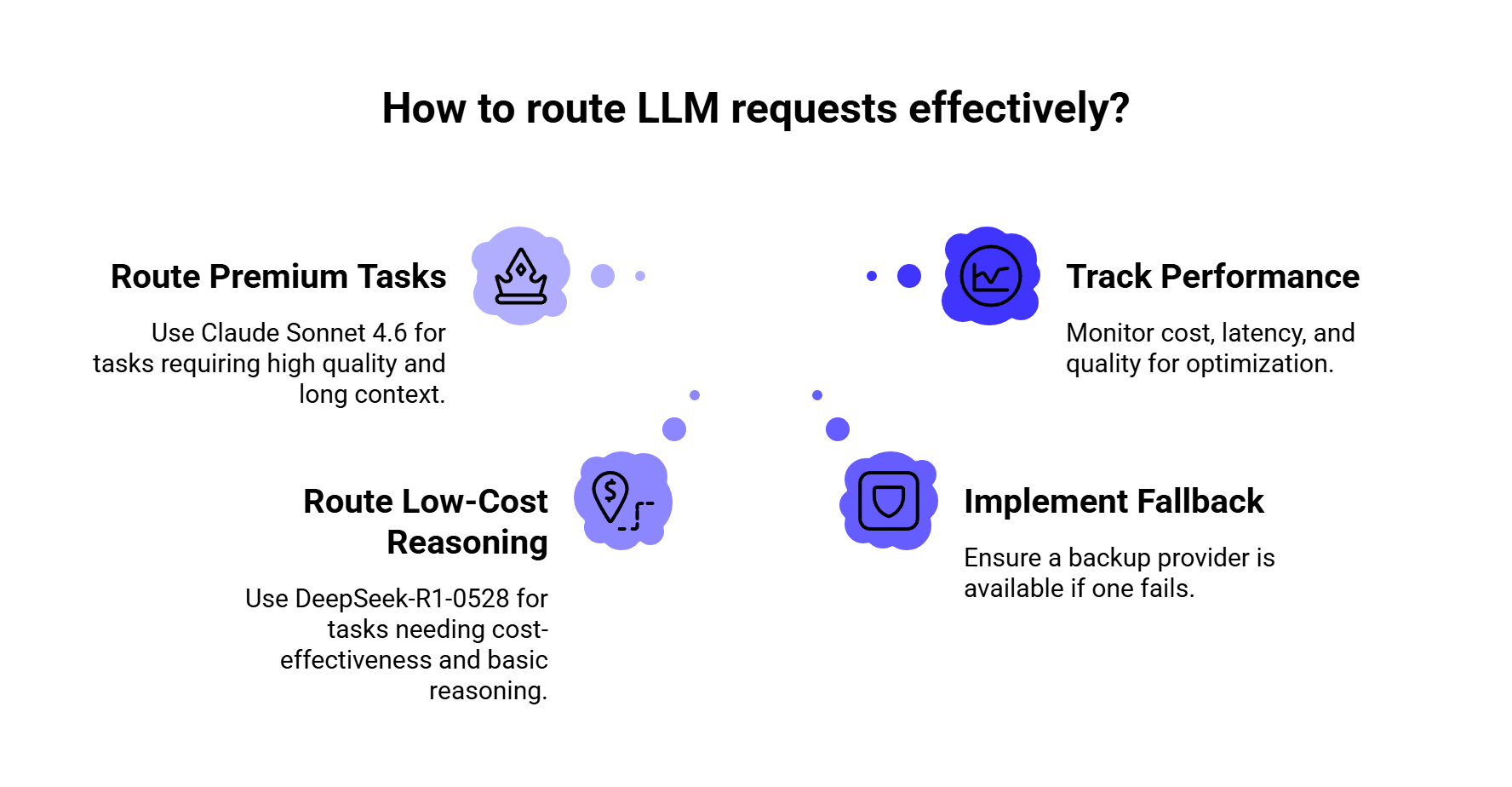
Claude Sonnet 4.6 and DeepSeek-R1-0528 can work together in the same AI stack. A gateway like LLMAPI helps route requests by task type, quality needs, cost, context size, and fallback rules.
| Task | Suggested route |
| Customer-facing answer | Claude Sonnet 4.6 |
| Long document review | Claude Sonnet 4.6 |
| Marketing copy | Claude Sonnet 4.6 |
| Coding agent | Claude Sonnet 4.6 |
| Math-heavy reasoning | DeepSeek-R1-0528 |
| Bulk classification | DeepSeek-R1-0528 |
| Internal summaries | DeepSeek-R1-0528 |
| Self-hosted analysis | DeepSeek-R1-0528 |
| Fallback workflow | Use LLMAPI routing |
LLMAPI helps teams manage these choices without hardcoding every provider separately. It can track usage, compare costs, manage fallback rules, and route tasks to the model that fits each job.
What to test before choosing
Benchmarks help, but your own workflow matters more.
| Test | Why it matters |
| Real user prompts | Shows actual instruction following |
| Long files | Tests context handling |
| Messy requests | Tests robustness |
| Coding tasks from your repo | Shows real developer value |
| JSON output | Important for apps |
| Tool calls | Important for agents |
| Editing time | Shows creative/business value |
| Safety-sensitive prompts | Important for production |
| Cost per accepted answer | Better than token price alone |
| Retry rate | Shows hidden cost |
| Fallback behavior | Important for reliability |
Suggested test setup:
| User group | Test this |
| Businesses | Reports, summaries, policy review, customer responses |
| Developers | Bugs, refactors, tests, repo tasks, API integrations |
| Creative teams | Blog drafts, landing pages, rewrites, brand voice |
| Startups | Cost per workflow, latency, retry rate |
| Researchers | Self-hosting, quantization, reasoning traces, safety behavior |
Final recommendation
Claude Sonnet 4.6 is the stronger choice for businesses, creative teams, enterprise workflows, long-context tasks, and production coding agents. It costs more, but it usually gives cleaner output, better writing, stronger hosted workflow quality, and better long-context support.
DeepSeek-R1-0528 is the stronger choice for low-cost reasoning, math-heavy tasks, open-weight research, self-hosting, and high-volume internal workloads. It is especially useful for developers and startups that need strong reasoning without premium hosted-model pricing.
The smartest setup can use both.
Use Claude Sonnet 4.6 for high-value work: customer-facing answers, business reports, legal or finance review, creative copy, long documents, and coding agents.
Use DeepSeek-R1-0528 for cost-sensitive work: batch reasoning, classification, internal automation, math-heavy prompts, code analysis, and open-source AI experiments.
Use LLMAPI when you want one workflow that can route between both models based on cost, quality, context length, and reliability.