
7 Best Named Entity Recognition APIs in 2026
The best named entity recognition APIs in 2026 are Amazon Comprehend for AWS apps and PII, Azure AI Language for Microsoft stacks and custom NER, Google Cloud Natural Language for entity sentiment, IBM Watson NLU for semantic analysis, TextRazor and Dandelion for entity linking, and Eden AI for comparing providers. Test the top three on your own text before choosing.
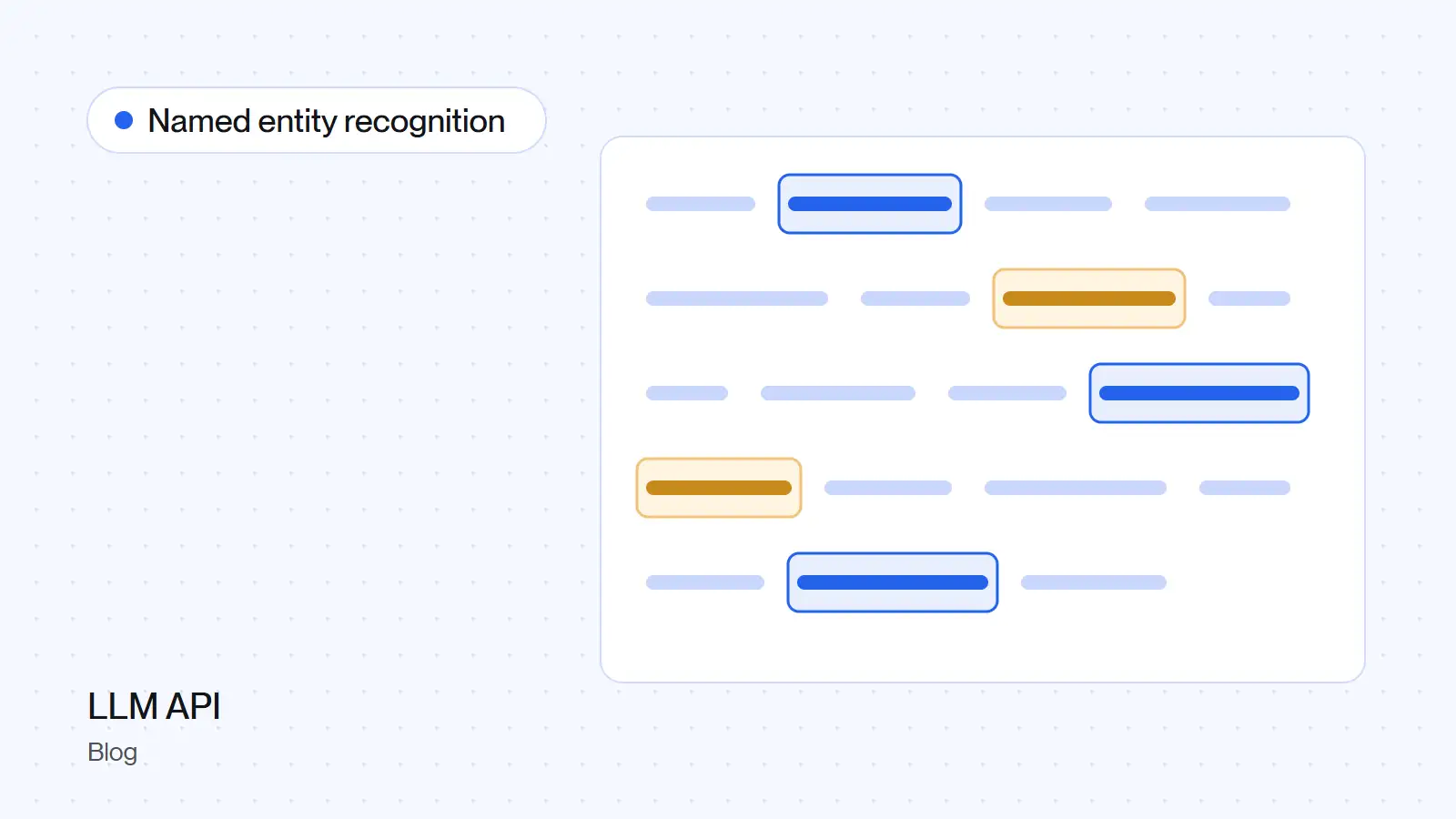
Named Entity Recognition sounds technical, but the idea is simple.
You give an API a piece of text, and it finds the important “things” inside it: people, companies, places, dates, products, money amounts, medical terms, account numbers, and other useful details.
For example, this sentence:
Apple opened a new office in Chicago on July 15, 2026.
Can become this:
[
  {
    "text": "Apple",
    "type": "organization"
  },
  {
    "text": "Chicago",
    "type": "location"
  },
  {
    "text": "July 15, 2026",
    "type": "date"
  }
]
That is useful for search, analytics, CRM enrichment, compliance checks, document processing, customer support, fraud review, healthcare workflows, media monitoring, and AI automation.
The hard part is choosing the right API.
Some NER APIs are better for business text. Some are stronger for cloud workflows. Some are better for entity linking, where the API connects “Apple” to the company instead of the fruit. Some are better for custom entity extraction, like policy numbers, claim IDs, product SKUs, or legal clause names.
So instead of treating every NER API like the same tool with a different logo, let’s look at what each one is actually good for.
First, What Kind of Entity Problem Do You Have?
Before picking an API, ask what you need to extract.
A simple NER task may look like this:
| Text type | Entities you may need |
|---|---|
| Customer support tickets | Product names, issue types, locations, dates |
| News articles | People, organizations, countries, events |
| Finance documents | Companies, money amounts, dates, account names |
| Legal documents | Parties, courts, dates, obligations |
| Healthcare notes | Conditions, medications, tests, treatments |
| E-commerce reviews | Brands, products, attributes |
| Internal emails | People, teams, projects, deadlines |
| AI prompts | Names, emails, addresses, private data |
That last one matters more now. Many apps use NER before sending text into an LLM workflow. For example, a system may extract names, company details, or PII first, then decide what to redact, route, summarize, or store.
NER research also keeps moving in this direction. The paper GPT-NER: Named Entity Recognition via Large Language Models explains that classic NER is usually treated as a sequence-labeling task, while LLM-based NER turns extraction into a generation task. That fits real apps because developers now often ask models to return entities as JSON, not just tag tokens inside text. The paper also warns about hallucination, which is why production NER workflows should validate results instead of blindly trusting every extracted entity.
How Should You Choose a NER API?
Here is the practical checklist.
| Question | Why it matters |
|---|---|
| Do you need standard entities or custom entities? | Standard APIs detect people, places, organizations, dates; custom workflows detect your own labels |
| Do you need entity linking? | Entity linking connects names to real-world concepts or knowledge graph IDs |
| Do you need PII detection? | PII workflows need privacy-specific labels and redaction support |
| Do you need medical or financial entities? | Domain-specific entities need stronger specialized models |
| Do you need multilingual support? | Entity accuracy can change a lot by language |
| Do you need confidence scores? | Scores help route uncertain results to review |
| Do you need cloud-native integration? | AWS, Azure, and Google fit best inside their own ecosystems |
| Do you need one API for many providers? | Aggregators help compare outputs and switch providers |
| Do you need output for LLM workflows? | Clean JSON, offsets, and stable labels matter |
NER can look easy on demos, but production text is messy. Company names get abbreviated. People use nicknames. Dates appear in many formats. Product names overlap with common words. “Amazon” may be a company, marketplace, river, or rainforest depending on context.
That is also why entity linking can matter. Raw NER may say “Apple = organization.” Entity linking tries to connect it to the right real-world entity. APIs like TextRazor and Dandelion are especially useful when you want semantic enrichment, not just labels.
Quick Picks by Use Case
| Use case | Best API to test first |
|---|---|
| AWS app with text analytics | Amazon Comprehend |
| Azure app or Microsoft stack | Azure AI Language |
| Google Cloud app | Google Cloud Natural Language |
| Enterprise semantic analysis | IBM Watson Natural Language Understanding |
| Entity linking and custom dictionaries | TextRazor |
| Short text and Wikipedia-style entity linking | Dandelion Entity Extraction API |
| Compare many NER providers through one API | Eden AI |
| LLM workflow after extraction | LLM API as routing layer |
Now let’s go through the 7 best NER APIs for 2026.
1. Amazon Comprehend
Amazon Comprehend is one of the best NER APIs if your app already runs on AWS.
The standard DetectEntities API returns entity text, entity type, begin and end offsets, and confidence scores. Those offsets matter because they let your app highlight entities in the original text, redact them, or link them back to the source sentence.
Amazon Comprehend can detect standard entities like people, locations, organizations, dates, quantities, commercial items, and more. It also supports custom entity recognition, which is useful when your business has entity types that generic NLP models do not know.
| Category | Details |
|---|---|
| Best for | AWS-native text analytics |
| Strongest fit | Support tickets, documents, PII workflows, custom entities |
| Output | Entity text, type, offsets, confidence |
| Custom entities | Yes |
| Good for developers? | Yes, especially AWS teams |
| Watch out for | Best value appears when your workflow already uses AWS |
Choose Amazon Comprehend if your app uses S3, Lambda, Textract, Step Functions, or other AWS services. It fits neatly into document workflows where text may come from PDFs, OCR, forms, or uploaded files.
Amazon Comprehend is also worth testing if privacy matters. Its pricing page highlights NLP features like PII detection and redaction, custom classification, and custom entity detection. That makes it useful for apps that need to detect names, addresses, financial details, or private customer information before storing or sending text elsewhere.
A research example here is Comprehend Medical: a Named Entity Recognition and Relationship Extraction Web Service. It focuses on Amazon Comprehend Medical, not the general Comprehend API, but it is still useful because it shows why domain-specific entity extraction matters. Medical text needs medication names, conditions, procedures, anatomy, protected health information, negation, and relationships. A generic “person/location/company” extractor would miss too much.
So for normal business text, use Amazon Comprehend. For medical entities, look at Amazon Comprehend Medical.
When Amazon Comprehend Makes Sense
| Need | Fit |
|---|---|
| AWS backend | Strong |
| PII detection | Strong |
| Custom entity recognition | Strong |
| Document workflows | Strong with Textract |
| Healthcare-specific NER | Use Comprehend Medical |
| Entity linking to Wikipedia-style concepts | Less focused |
2. Azure AI Language
Azure AI Language is a strong NER choice for teams already using Microsoft tools.
Azure’s Named Entity Recognition feature can identify entities such as people, locations, organizations, dates, quantities, email addresses, URLs, IP addresses, and more. Microsoft’s docs also cover data limits for Language service features, which is important before building production workflows around long documents or high-volume text.
| Category | Details |
|---|---|
| Best for | Microsoft/Azure apps |
| Strongest fit | Enterprise text analytics, PII workflows, business documents |
| Output | Entity categories, subcategories, offsets, confidence |
| Custom entities | Available through Azure custom NER |
| Good for developers? | Yes, especially Azure teams |
| Watch out for | Pick the right Azure Language feature for your workflow |
Azure is a good fit if your company already uses Azure Storage, Azure Functions, Microsoft Entra ID, Power Platform, SharePoint, or Microsoft security tools.
It is also useful when NER is part of a wider enterprise workflow. For example, a company may use Azure Document Intelligence to extract text from PDFs, then Azure AI Language to detect entities, then a database or Power BI dashboard to track customers, vendors, projects, or locations.
Azure’s custom NER option is especially useful when normal labels are too generic. For example, a logistics app may need labels like shipment_id, carrier_name, delivery_window, and warehouse_location. A legal app may need court_name, case_number, party_name, and clause_reference.
NER research supports this idea of label design. The paper Named Entity Recognition via Machine Reading Comprehension: A Multi-Task Learning Approach explains that entity types are connected, and label relationships can affect recognition quality. In normal human language, this means your labels should make sense together. If your custom labels overlap too much, the model can get confused.
When Azure AI Language Makes Sense
| Need | Fit |
|---|---|
| Azure or Microsoft stack | Strong |
| Enterprise workflows | Strong |
| PII and standard entities | Strong |
| Custom NER | Strong |
| Long document processing | Check limits and chunking |
| Semantic entity linking | Less focused than TextRazor or Dandelion |
3. Google Cloud Natural Language
Google Cloud Natural Language is a good choice for teams using Google Cloud or apps that need entity extraction with clean cloud APIs.
Google’s Natural Language API basics explain that Entity Analysis identifies entities in text, including famous people, landmarks, common objects, and other named things. The analyzeEntities method returns recognized entities, mentions, probability, types, and other properties.
| Category | Details |
|---|---|
| Best for | Google Cloud text analytics |
| Strongest fit | Entity analysis, sentiment around entities, content analytics |
| Output | Entities, types, mentions, salience/probability-style signals |
| Custom entities | Less central than cloud AutoML-style workflows |
| Good for developers? | Yes |
| Watch out for | Pricing is character/unit based, so estimate with real volume |
Google Cloud Natural Language is especially useful when you want entity analysis and entity sentiment. Entity sentiment is helpful when the question is not just “Which company is mentioned?” but “How does the text feel about that company?”
For example:
The battery life on the Pixel phone is great, but the customer support was terrible.
A normal entity extractor may find Pixel and customer support. Entity sentiment can help show that one entity is discussed positively and another negatively.
Google’s pricing page explains that Natural Language API pricing is based on Unicode characters counted in units. That is one of those boring details that becomes very important in production. A tiny demo can feel cheap. A high-volume review analytics system may need careful cost estimates.
Google Cloud Natural Language is a good fit for:
| Need | Fit |
|---|---|
| Google Cloud stack | Strong |
| Entity sentiment | Strong |
| Content analytics | Strong |
| Review analysis | Strong |
| Custom domain labels | May need extra setup |
| One API for multiple providers | Use Eden AI or LLM API around it |
Research around entity extraction often highlights context. One helpful example is Named Entity Analysis and Extraction with Uncommon Words, which discusses how uncommon words can help distinguish named entities from normal text. This fits entity analysis well because names, brands, and organizations often behave differently from common words. The tricky part is that product names and brands can also become everyday words, so real evaluation still matters.
4. IBM Watson Natural Language Understanding
IBM Watson Natural Language Understanding is a strong option for enterprise semantic analysis.
IBM’s docs say Watson NLU can analyze semantic features such as categories, concepts, emotion, entities, keywords, metadata, relations, semantic roles, and sentiment. The IBM Cloud docs also explain that you can send text, HTML, or a public URL and request features like entities, keywords, concepts, sentiment, and categories.
| Category | Details |
|---|---|
| Best for | Enterprise semantic text analysis |
| Strongest fit | Entities plus categories, concepts, relations, and sentiment |
| Output | Entities, types, sentiment, relevance, mentions, and more |
| Custom entities | Available through Watson tooling depending on setup |
| Good for developers? | Yes, especially enterprise teams |
| Watch out for | Better for semantic analysis than tiny lightweight apps |
IBM Watson NLU is useful when entities are part of a larger understanding workflow.
For example, a media monitoring app may want:
- People and companies mentioned.
- Sentiment around each entity.
- Keywords and concepts.
- Categories for the article.
- Relations between entities.
That wider semantic layer is where IBM can make sense.
A research paper called A Comparison of Natural Language Understanding Platforms for Chatbots in Software Engineering compared platforms including IBM Watson, Google Dialogflow, Rasa, and Microsoft LUIS for software engineering chatbot tasks. It found that NLU platform choice matters by task, and some tools perform better for entity extraction in specific domains. This fits our point here: do not choose a NER API by brand alone. Test it on your actual text type.
When IBM Watson NLU Makes Sense
| Need | Fit |
|---|---|
| Enterprise semantic analysis | Strong |
| Entities plus sentiment/concepts | Strong |
| URL or HTML analysis | Useful |
| Chatbot/NLU pipelines | Useful |
| Lightweight quick NER | May be more than you need |
| Cloud-native AWS/Azure/GCP workflow | Pick your cloud provider first |
5. TextRazor
TextRazor is a strong NER API when you care about entity linking, semantic enrichment, and custom dictionaries.
The TextRazor REST API docs explain that callers can choose extractors to control which language analysis features they want. TextRazor also supports Entity Dictionaries, which let teams add custom entities relevant to their application.
That is a big deal.
Standard NER might detect “Stripe” as an organization. Entity linking can connect it to the payment company. A custom dictionary can also tell the system that an internal product name, campaign name, or customer tier should be treated as a specific entity.
| Category | Details |
|---|---|
| Best for | Entity linking and semantic enrichment |
| Strongest fit | News, publishing, search, knowledge graphs, custom dictionaries |
| Output | Entities, categories, topics, relations, and other semantic data |
| Custom entities | Yes, through Entity Dictionaries |
| Good for developers? | Yes |
| Watch out for | May be heavier than needed for basic NER |
TextRazor is a good fit when you need to understand what an entity refers to.
For example:
Jordan announced a new partnership with Apple.
Does “Jordan” mean a person, a country, a brand, or something else? Context decides. Entity linking and confidence signals help.
Research on approximate entity extraction is relevant here. The paper Entity Extraction using Both Character-based and Token-based Similarity explains how entity matching has to deal with spelling errors, name variations, and token-level differences. That fits custom dictionaries because real business names are messy: “OpenAI,” “Open AI,” “OpenAI Inc.,” and “OpenAI, LLC” may need to point to the same entity.
When TextRazor Makes Sense
| Need | Fit |
|---|---|
| Entity linking | Strong |
| Knowledge graph enrichment | Strong |
| Custom entity dictionaries | Strong |
| Publishing/media/search | Strong |
| Simple PII detection | Use AWS/Azure/Google instead |
| Lowest-complexity setup | May be more than a basic app needs |
6. Dandelion Entity Extraction API
Dandelion Entity Extraction API is a good option when you want entity extraction and linking in a lightweight API.
Its docs describe it as a named entity extraction and linking API that can work well on short texts. It can extract entities, tag text, connect entities to Wikipedia-style concepts, and return enriched data.
That makes Dandelion useful for content apps, social media analysis, article tagging, recommendation systems, and knowledge graph enrichment.
| Category | Details |
|---|---|
| Best for | Short text, article tagging, entity linking |
| Strongest fit | Media, publishing, search, lightweight semantic tagging |
| Output | Linked entities, confidence, categories, abstracts, metadata |
| Custom entities | Less central than TextRazor dictionaries |
| Good for developers? | Yes |
| Watch out for | Best for semantic entity extraction/linking, not every enterprise workflow |
Dandelion is useful when entity context matters.
For example:
Tesla shares rose after the announcement.
A linked entity API can help connect “Tesla” to the company, not Nikola Tesla, the unit of magnetic flux density, or something else.
Dandelion’s getting started docs show how to call the API with text and include fields like types, abstracts, and categories. That makes it friendly for developers building quick text enrichment features.
When Dandelion Makes Sense
| Need | Fit |
|---|---|
| Entity extraction from short text | Strong |
| Wikipedia-style linking | Strong |
| Article tagging | Strong |
| Search enrichment | Strong |
| Enterprise compliance workflow | Less focused |
| Custom business labels | Less focused than Azure custom NER or TextRazor dictionaries |
7. Eden AI Named Entity Recognition API
Eden AI Named Entity Recognition API gives you access to multiple NER providers through one API. Its NER docs show a unified endpoint pattern for named entity recognition.
This is useful if you do not want to pick one provider immediately.
You can compare outputs, route requests, and keep your app less tied to one vendor. That matters because NER accuracy depends heavily on text type, language, domain, and labels.
| Category | Details |
|---|---|
| Best for | Comparing multiple NER providers |
| Strongest fit | Teams testing accuracy, cost, and provider fit |
| Output | Unified NER response across providers |
| Custom entities | Eden also has custom NER options |
| Good for developers? | Yes |
| Watch out for | Check which underlying providers and models fit your use case |
Eden AI is a good fit when you want flexibility.
For example, you may test AWS, Google, and other providers through a unified interface, then choose the one that performs best on your data. Or you may keep multiple providers available so your app can route by language, cost, or availability.
This is also where modern LLM workflow thinking matters. A paper called API Entity and Relation Joint Extraction from Text via Dynamic Prompt-tuned Language Model looks at extracting API entities and relations from software text using prompt-tuned language models. The details are software-engineering specific, but the lesson fits many custom NER workflows: when entities are domain-specific, prompt-based or custom extraction can reduce the need for huge labeled datasets.
Eden AI is useful if your team wants to test that kind of provider flexibility before building a custom model or committing to one cloud platform.
When Eden AI Makes Sense
| Need | Fit |
|---|---|
| Compare NER providers | Strong |
| Unified API | Strong |
| Multi-provider fallback | Useful |
| Custom NER testing | Useful |
| Deep cloud-native integration | Direct AWS/Azure/Google may fit better |
| Entity linking specialty | TextRazor or Dandelion may be stronger |
Side-by-Side: Which NER API Should You Pick?
Here is the more practical comparison.
| API | Choose it when | Main tradeoff |
|---|---|---|
| Amazon Comprehend | You use AWS and need standard/custom entities or PII workflows | Strongest inside AWS |
| Azure AI Language | You use Microsoft/Azure and need enterprise NER or custom NER | Requires Azure setup choices |
| Google Cloud Natural Language | You use Google Cloud and want entity analysis or entity sentiment | Pricing depends on character volume |
| IBM Watson NLU | You need entities plus concepts, categories, sentiment, and relations | Better for wider semantic analysis |
| TextRazor | You need entity linking, custom dictionaries, or semantic enrichment | More specialized than basic NER |
| Dandelion | You need entity linking for short text, articles, or content tagging | Less focused on custom enterprise labels |
| Eden AI | You want one API to compare several NER providers | Underlying provider choice still matters |
If your team already lives in one cloud, start there. AWS teams should test Amazon Comprehend. Azure teams should test Azure AI Language. Google Cloud teams should test Google Cloud Natural Language.
If your product needs semantic enrichment, test TextRazor and Dandelion.
If you are still comparing providers, test Eden AI.
What About LLMs for NER?
LLMs can do NER too.
You can ask a model:
Extract people, companies, products, dates, and money amounts from this text.
Return valid JSON only.
That can work very well when the entity labels are custom or weird.
For example:
| Custom label | Example |
|---|---|
| competitor_name | “We switched from HubSpot to Salesforce.” |
| refund_reason | “The product arrived damaged.” |
| legal_party | “Agreement between Acme Inc. and Northwind LLC.” |
| risk_event | “The payment failed after three attempts.” |
| feature_request | “Please add invoice reminders.” |
The problem is consistency. LLMs can return extra fields, miss offsets, or infer entities that are not explicitly present. That is why classic NER APIs still matter.
The GPT-NER paper is useful here because it explains both the promise and the risk. LLMs can adapt to low-resource NER setups, but hallucination needs self-verification and careful prompting.
A practical setup is:
- Use a NER API for standard entities.
- Use an LLM for custom or fuzzy labels.
- Validate the output against a strict schema.
- Send uncertain results to review.
Where LLM API Fits
LLM API fits when NER is part of a bigger AI workflow.
A NER API extracts entities. LLM API can help route the follow-up work across models.
For example:
- Your app sends customer text into a NER API.
- The NER API extracts names, companies, dates, locations, and products.
- LLM API routes a follow-up task to the best model.
- A cheaper model handles simple classification.
- A stronger model handles legal, finance, or customer-facing output.
- A fallback model runs if one provider fails.
- Your app stores the result with cost and usage tracking.
This is useful for workflows like:
| Workflow | How LLM API helps |
|---|---|
| Support ticket routing | Extract entities, then classify urgency |
| CRM enrichment | Extract companies and people, then summarize account context |
| Compliance review | Extract PII, then explain risk flags |
| Legal document analysis | Extract parties and dates, then summarize obligations |
| Financial document processing | Extract companies and amounts, then check inconsistencies |
| Media monitoring | Extract entities, then summarize sentiment and trends |
The cleanest way to think about it: NER finds the important things. LLM API helps decide what your app should do with those things.
What Should You Test Before Choosing?
Do not test a NER API on one perfect sentence.
Use real text from your app.
Test:
| Test type | Why it matters |
|---|---|
| Short messages | Many APIs struggle with little context |
| Long documents | Some APIs have size limits |
| Messy user text | Typos and slang affect results |
| Industry terms | Generic models may miss domain entities |
| Names with punctuation | Company names often include symbols |
| Multilingual text | Accuracy varies by language |
| Ambiguous entities | “Apple,” “Jordan,” “Amazon,” “Java” |
| Custom labels | Standard NER may be too generic |
| PII-heavy text | Privacy workflows need careful extraction |
| Entity offsets | Needed for highlighting and redaction |
Build a small test set with 100 examples. Mark the correct entities manually. Then compare each API.
Track these metrics:
| Metric | What it tells you |
|---|---|
| Precision | How many extracted entities were correct |
| Recall | How many real entities the API found |
| F1 score | Balanced accuracy |
| False positives | Entities the API invented or mislabeled |
| False negatives | Entities the API missed |
| Offset accuracy | Whether highlights/redaction work |
| Label accuracy | Whether types are correct |
| Latency | Whether the API is fast enough |
| Cost per 1,000 texts | Whether it scales |
| Review rate | How often humans need to fix results |
Multilingual testing deserves special attention. The MasakhaNER paper created NER datasets for 10 African languages and showed how underrepresented many languages are in NLP resources. This matters for API buyers because “supports many languages” does not always mean “works equally well in every language.” Test the exact languages your users write in.
Common Mistakes When Choosing a NER API
| Mistake | Better approach |
|---|---|
| Choosing only by price | Test accuracy and review cost |
| Testing only English | Test every real user language |
| Ignoring entity offsets | Offsets are needed for highlighting and redaction |
| Mixing similar custom labels | Keep labels clear and separate |
| Using one API for every domain | Use specialized tools for medical, legal, or finance text |
| Trusting every extracted entity | Add confidence thresholds |
| Skipping review for sensitive data | Add review for PII, finance, legal, and healthcare |
| Forgetting entity linking | Use linking when names are ambiguous |
| No fallback plan | Add backup providers or LLM-based extraction |
The biggest mistake is treating NER like a solved checkbox. Real accuracy depends on your text, language, labels, and workflow.
Final Ranking
| Rank | API | Best for |
|---|---|---|
| 1 | Amazon Comprehend | AWS apps, PII, custom entities, document workflows |
| 2 | Azure AI Language | Microsoft/Azure enterprise NER and custom NER |
| 3 | Google Cloud Natural Language | Google Cloud entity analysis and entity sentiment |
| 4 | IBM Watson Natural Language Understanding | Enterprise semantic text analysis |
| 5 | TextRazor | Entity linking, custom dictionaries, knowledge enrichment |
| 6 | Dandelion Entity Extraction API | Short text, article tagging, linked entities |
| 7 | Eden AI | Comparing multiple NER providers through one API |
This ranking is based on general usefulness for developers and business apps in 2026. Your final choice should depend on your real text samples.
Final Thoughts
The best Named Entity Recognition API depends on what kind of entities your app needs.
Choose Amazon Comprehend if you already use AWS and need entity extraction, PII detection, or custom entities. Choose Azure AI Language if your workflow lives in Microsoft’s ecosystem and you want enterprise-friendly NER. Choose Google Cloud Natural Language if you want entity analysis, entity sentiment, and Google Cloud integration.
Choose IBM Watson NLU if entities are part of a wider semantic analysis workflow. Choose TextRazor if entity linking and custom dictionaries matter. Choose Dandelion if you need lightweight entity extraction and linking for short text or content tagging. Choose Eden AI if you want to compare several NER providers without wiring each one separately.
For LLM workflows, use NER as the structured extraction layer, then use LLM API to route follow-up tasks like classification, summarization, redaction, compliance checks, and fallback handling.
The practical advice is simple: pick three APIs, test them on your own text, compare precision and recall, then choose the one that creates the least cleanup for your team.