Open-source LLMs are easier to download than they are to run well.
That part catches a lot of teams off guard. You can grab a model from Hugging Face in minutes, but serving it in a real app means dealing with GPUs, VRAM, cold starts, batching, autoscaling, latency, model versions, logs, rate limits, and cost. Suddenly, “we’ll just host Llama ourselves” becomes a tiny infrastructure goblin with a monthly GPU bill.
That is why LLM hosting providers matter. They give developers a faster way to run open-weight models like Llama, Mistral, Qwen, DeepSeek, Gemma, and other popular models without building the full serving layer from scratch.
For this guide, we reviewed 6 provider options for hosting or running open-source LLMs: Hugging Face Inference Endpoints, Together AI, Fireworks AI, Baseten, RunPod, and Replicate. We compared them by model support, deployment style, pricing model, scaling behavior, developer experience, customization, and workflow fit.
We also looked at where LLMAPI fits after the hosting layer. A hosting provider runs the model. LLM API can help teams route requests across models, track usage, manage keys, compare providers, and connect hosted LLMs into larger AI workflows.
The hosting problem: What are you actually buying?
When people say “LLM hosting,” they may mean very different things.
Some teams want a simple hosted API for open-source models. Some want a dedicated endpoint for one model. Some need serverless GPU workers. Some want to bring their own fine-tuned model. Others just want to test a model before deciding whether it deserves production infrastructure.
So before choosing a provider, we’d separate the options like this:
| Hosting style | What it means | Best for |
| Serverless inference API | Call shared hosted models by token/request | Prototypes, variable traffic, quick testing |
| Dedicated endpoint | One model runs on reserved infrastructure | Production apps with steady traffic |
| GPU cloud / pods | You rent GPU machines and deploy your own stack | Teams that want more control |
| Model packaging platform | You package a model and expose it as an API | Custom models and repeatable deployments |
| Inference gateway | Route requests across hosted models/providers | Multi-model apps, fallback, cost control |
The best provider depends on which row you actually need. A serverless API is great when traffic is unpredictable. A dedicated endpoint can be cheaper and more stable when usage is steady. Raw GPU infrastructure gives control, but the team has to own more of the ops.
Research backs up why this choice matters. The vLLM paper, Efficient Memory Management for Large Language Model Serving with PagedAttention, found that inefficient key-value cache memory management can limit batch size and waste GPU memory. vLLM’s PagedAttention approach improved throughput by 2–4x compared with earlier systems at the same latency level. In plain terms: model serving is not only “put model on GPU.” The serving engine, batching strategy, and memory management can completely change the cost and speed of your deployment.
How we evaluated these providers
Our team has spent 6 years researching AI APIs, SaaS infrastructure, developer platforms, and model deployment workflows. For this article, we looked at official product docs, pricing pages, deployment guides, model catalogs, and current research on LLM serving systems.
We focused on practical questions:
| Question | Why it matters |
| Can you run popular open-source models quickly? | Most teams want Llama, Mistral, Qwen, DeepSeek, Gemma, or similar models |
| Can you bring your own model? | Fine-tuned and private models need custom deployment options |
| Is pricing token-based, GPU-hour-based, or per-second? | Cost changes a lot depending on traffic shape |
| Does it scale down when idle? | Important for prototypes and bursty apps |
| Does it support dedicated infrastructure? | Important for production latency and reliability |
| Is the API easy to integrate? | OpenAI-compatible endpoints reduce migration work |
| Can it support workflows beyond one model? | Real apps often need routing, fallbacks, monitoring, and cost control |
We also treated “best” as use-case dependent. A provider can be excellent for rapid prototyping and still be expensive for 24/7 production. Another provider can be powerful for infrastructure teams and too much work for a small app team.
Quick verdict: Which provider should you try first?
| Need | Best first choice |
| Easiest path from Hugging Face model to managed endpoint | Hugging Face Inference Endpoints |
| Broad open-source model API with serverless and dedicated options | Together AI |
| Fast open-source model serving with production API focus | Fireworks AI |
| Dedicated inference for custom and fine-tuned models | Baseten |
| GPU control with serverless and pod options | RunPod |
| Fast model demos and custom model packaging | Replicate |
| Routing across hosted models and providers | LLMAPI |
If we had to pick one starting point for most teams, we’d test Together AI or Fireworks AI for hosted open-source model APIs. If the team already lives on Hugging Face, Hugging Face Inference Endpoints is the cleanest path. If you need deeper deployment control, look at Baseten or RunPod. If you want fast demos and simple custom model packaging, Replicate is a friendly option.
Hugging Face Inference Endpoints
Best for: teams that want to deploy Hugging Face models without building the serving stack.
Hugging Face Inference Endpoints is one of the most natural choices if your model already lives on Hugging Face. The service lets teams deploy AI models to managed infrastructure, with autoscaling, observability, and deployment options that reduce the need to manage your own servers.
Hugging Face’s pricing docs explain that endpoint pricing is shown hourly, while actual cost is calculated by the minute. That detail matters because it gives more flexibility than a full-month server commitment, but you still need to pause or scale endpoints properly if traffic drops.
| Category | Details |
| Hosting style | Managed dedicated endpoints |
| Best for | Hugging Face-native teams and production model deployment |
| Model support | Strong for Hugging Face Hub models |
| Pricing model | Instance-based, billed by minute |
| Main strength | Easy path from model repo to production endpoint |
| Main weakness | Can become expensive for always-on GPU endpoints |
Compared with Together AI and Fireworks AI, Hugging Face gives you a more direct route from the Hugging Face Hub to managed infrastructure. Together and Fireworks are usually stronger when you want a large hosted catalog with token-based serverless inference.
Compared with RunPod, Hugging Face is more managed. RunPod gives more infrastructure control, but you own more of the setup.
We’d choose Hugging Face Inference Endpoints if the team already works with Hugging Face models, private repos, or Transformers-based workflows. It is also a good fit when you want dedicated production endpoints without building GPU infrastructure yourself.
We’d watch the cost carefully for 24/7 production traffic. Dedicated endpoints are convenient, but always-on GPUs can become expensive if utilization is low.
Together AI
Best for: serverless open-source model inference with room to grow into dedicated endpoints.
Together AI lets teams run, train, and serve open-source AI models. Its docs describe an OpenAI-compatible API for running leading open-source models, plus fine-tuning and deployment options. The inference overview explains that Together supports both serverless models and dedicated endpoints: serverless for popular open models with no GPUs to manage, and dedicated endpoints for steady traffic or fine-tuned models.
That split is useful. You can start with serverless inference while traffic is uncertain, then move to dedicated infrastructure when usage becomes predictable.
| Category | Details |
| Hosting style | Serverless inference + dedicated endpoints |
| Best for | Open-source model APIs, scaling from prototype to production |
| Model support | 100+ open-source models in docs; broader model catalog on site |
| Pricing model | Token-based serverless; hardware/minute for dedicated endpoints |
| Main strength | Strong balance of ease, model access, and scaling paths |
| Main weakness | Pricing depends heavily on model and workload shape |
Together’s serverless model docs say serverless models bill based on usage, with no minimums and no provisioning cost. The same docs note that batch workloads can receive discounted pricing on some models. That makes Together attractive for teams that process both real-time and offline workloads.
Compared with Hugging Face, Together is usually better when you want a hosted catalog of open models through one API. Hugging Face is better when your deployment starts from a specific Hugging Face repo or private model.
Compared with Fireworks AI, the choice is closer. Both are strong open-source LLM inference providers. We’d compare them on the exact model you need, latency, token pricing, context length, and fine-tuning requirements.
We’d choose Together AI if we wanted a flexible open-source model provider that supports both quick API calls and a path toward dedicated deployments.
Fireworks AI
Best for: production-focused open-source LLM APIs and fast inference workflows.
Fireworks AI is built around fast inference, model APIs, fine-tuning, and production deployment for open-source and custom models. Its own 2026 comparison of LLM API providers places Fireworks alongside providers like OpenRouter, Hugging Face, Together AI, Groq, Cerebras, Baseten, and Modal, which is useful market context even though it comes from a vendor.
Fireworks is a strong option when teams want an API-style experience for open models without managing GPU infrastructure directly.
| Category | Details |
| Hosting style | Serverless inference and production model APIs |
| Best for | Fast open-source LLM serving and fine-tuned model workflows |
| Model support | Popular open-weight models and custom deployments |
| Pricing model | Model/API based |
| Main strength | Strong production inference focus |
| Main weakness | Provider comparison should be done per model, not by brand alone |
Compared with Together AI, Fireworks is one of the closest alternatives. Both are strong for hosted open-source LLM inference. The winner usually depends on the exact model, latency target, context window, fine-tuning needs, and pricing for your traffic shape.
Compared with Replicate, Fireworks is more focused on production LLM inference. Replicate feels friendlier for quick demos and broader ML model experiments.
We’d choose Fireworks AI if we needed production-grade hosted inference for popular open-source LLMs and wanted a managed API rather than raw GPU infrastructure.
We’d test Fireworks and Together side by side using the same prompts, same model class, same output length, and same concurrency. Tiny benchmark differences can disappear in real traffic, while cost and reliability differences show up fast.
Baseten
Best for: dedicated inference for custom, open-source, and fine-tuned models.
Baseten positions itself as an inference platform for serving open-source, custom, and fine-tuned AI models on infrastructure built for high-performance inference. Its docs say the most common way to deploy a model is with Truss, an open-source framework that packages models into deployable containers.
Baseten’s model development docs explain that teams can package a model with Truss, push it to Baseten, and get deployment, autoscaling, and observability. Its first model guide says developers can pick an open-source model from Hugging Face, choose a GPU, and get an endpoint in minutes.
| Category | Details |
| Hosting style | Dedicated inference and model deployment platform |
| Best for | Custom models, fine-tuned models, high-scale inference |
| Model support | Open-source, custom, and fine-tuned models |
| Pricing model | Infrastructure/deployment based |
| Main strength | Strong production deployment tooling |
| Main weakness | More involved than simple token-based APIs |
Compared with Together AI and Fireworks AI, Baseten is stronger when you want to deploy your own model and control the production environment more closely. Together and Fireworks are easier if you just want hosted APIs for popular open models.
Compared with RunPod, Baseten is more managed and model-serving focused. RunPod gives more raw infrastructure flexibility.
We’d choose Baseten if the team has a fine-tuned model, a custom inference stack, or production requirements around observability, dedicated capacity, and model lifecycle management.
Baseten also makes sense when latency and reliability matter more than the cheapest possible GPU hour. For some teams, paying more for managed deployment, observability, and support is still cheaper than hiring people to maintain the whole serving stack.
RunPod
Best for: teams that want GPU control with pods, serverless endpoints, and infrastructure flexibility.
RunPod is more infrastructure-oriented than most providers in this list. It offers GPU pods for development and long-running jobs, serverless endpoints for API workloads, and clusters for larger jobs. Its pricing page explains that Pods are dedicated GPU instances, Serverless bills inference workers based on usage, and Clusters support multi-node workloads and reserved capacity.
RunPod’s serverless product page highlights serverless GPU endpoints, autoscaling, per-millisecond billing, flexible runtimes, and inference workloads for image, text, and audio generation.
| Category | Details |
| Hosting style | GPU pods, serverless GPU endpoints, clusters |
| Best for | Teams that want more infrastructure control |
| Model support | Bring your own containers, frameworks, and models |
| Pricing model | GPU/workload based |
| Main strength | Flexible GPU infrastructure |
| Main weakness | More ops work than managed model APIs |
RunPod also has documentation for deploying vLLM on RunPod Serverless, which matters because vLLM has become a common serving engine for open-source LLMs.
Compared with Hugging Face, Together, and Fireworks, RunPod gives more infrastructure control. That is good if your team knows how to manage containers, serving engines, and GPU sizing. It is less good if you want a fully managed “call this model by API” experience.
Compared with Baseten, RunPod is more flexible infrastructure. Baseten is more model-deployment platform.
We’d choose RunPod if we wanted to run vLLM, SGLang, TensorRT-LLM, custom containers, or experimental open-source models with more control over GPU choice and deployment shape.
Research on serverless LLMs explains why this kind of platform exists. The 2025 paper Tangram: Accelerating Serverless LLM Loading through GPU Memory Reuse and Affinity found that serverless LLM cold starts are heavily affected by model loading, and reported up to 6.2x faster loading plus 23–55% lower time-to-first-token during cold start compared with prior approaches. That is the core tradeoff with serverless GPU: it can reduce idle cost, but cold-start and model-loading behavior matter a lot.
Replicate
Best for: quick model demos, public APIs, and custom model packaging with Cog.
Replicate lets developers run machine learning models through APIs and deploy custom models. Its custom model deployment docs explain that teams can choose hardware for their model, starting with smaller GPUs for development and moving to larger GPUs like A100s or H100s later.
Replicate’s pricing page says developers are not limited to public models and can deploy custom models using Cog, Replicate’s open-source packaging tool. The open-source docs explain that Cog packages machine learning models in standard production-ready Docker containers.
| Category | Details |
| Hosting style | Serverless model API + custom model deployment |
| Best for | Fast demos, model experiments, custom packaged models |
| Model support | Public models plus custom Cog deployments |
| Pricing model | Hardware/runtime based |
| Main strength | Simple path from model to hosted API |
| Main weakness | Long-running high-volume workloads may need cost comparison |
Compared with RunPod, Replicate is easier for demos and API-first model sharing. RunPod gives more infrastructure control.
Compared with Baseten, Replicate feels lighter and more experimentation-friendly. Baseten is more enterprise production deployment oriented.
We’d choose Replicate if the team wants to quickly expose a model as an API, test public models, or package custom models without setting up a full serving platform.
Replicate is also useful for multimodal workflows, not only LLMs. If your app uses image, video, audio, or diffusion models alongside text models, Replicate can be a practical experimentation layer.
Provider comparison: Which one is better for what?
Here is the direct comparison your team probably wants before choosing.
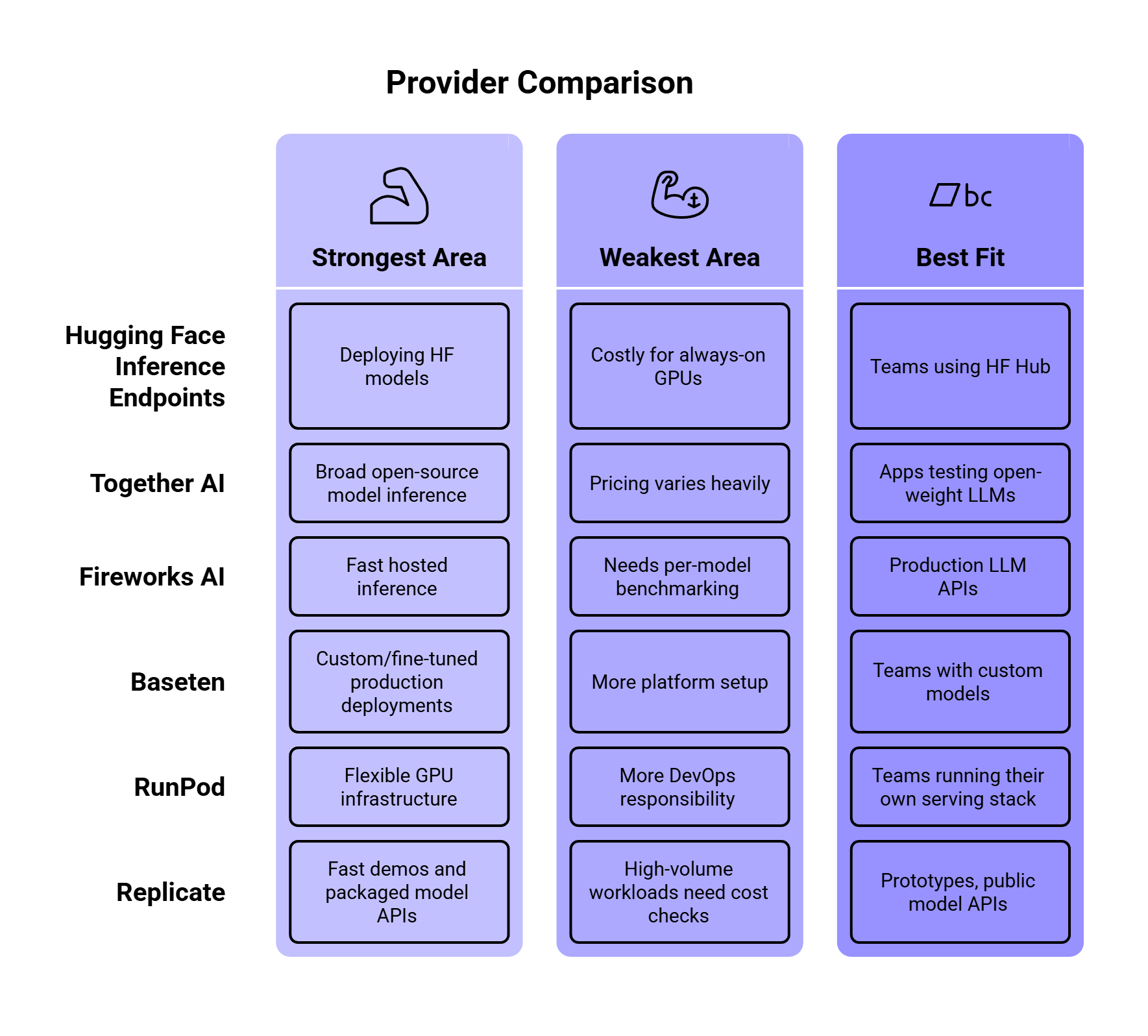
| Provider | Strongest area | Weakest area | Best fit |
| Hugging Face Inference Endpoints | Deploying Hugging Face models to managed endpoints | Can be costly for always-on GPUs | Teams already using HF Hub/private models |
| Together AI | Broad open-source model inference with serverless and dedicated paths | Pricing varies heavily by model/workload | Apps testing and scaling open-weight LLMs |
| Fireworks AI | Fast hosted inference for open-source models | Needs per-model benchmarking | Production LLM APIs and fine-tuned model workflows |
| Baseten | Custom/fine-tuned production deployments | More platform setup than simple APIs | Teams with custom models and reliability needs |
| RunPod | Flexible GPU infrastructure | More DevOps responsibility | Teams running their own serving stack |
| Replicate | Fast demos and packaged model APIs | High-volume workloads need cost checks | Prototypes, public model APIs, custom ML demos |
Our top overall pick for most app teams is Together AI, because it balances serverless open-source model access with a path to dedicated endpoints.
Our top pick for teams already inside the Hugging Face ecosystem is Hugging Face Inference Endpoints.
Our top pick for custom production deployments is Baseten.
Our top pick for infrastructure control is RunPod.
Our top pick for demos and model experiments is Replicate.
What about Groq, Modal, and OpenRouter?
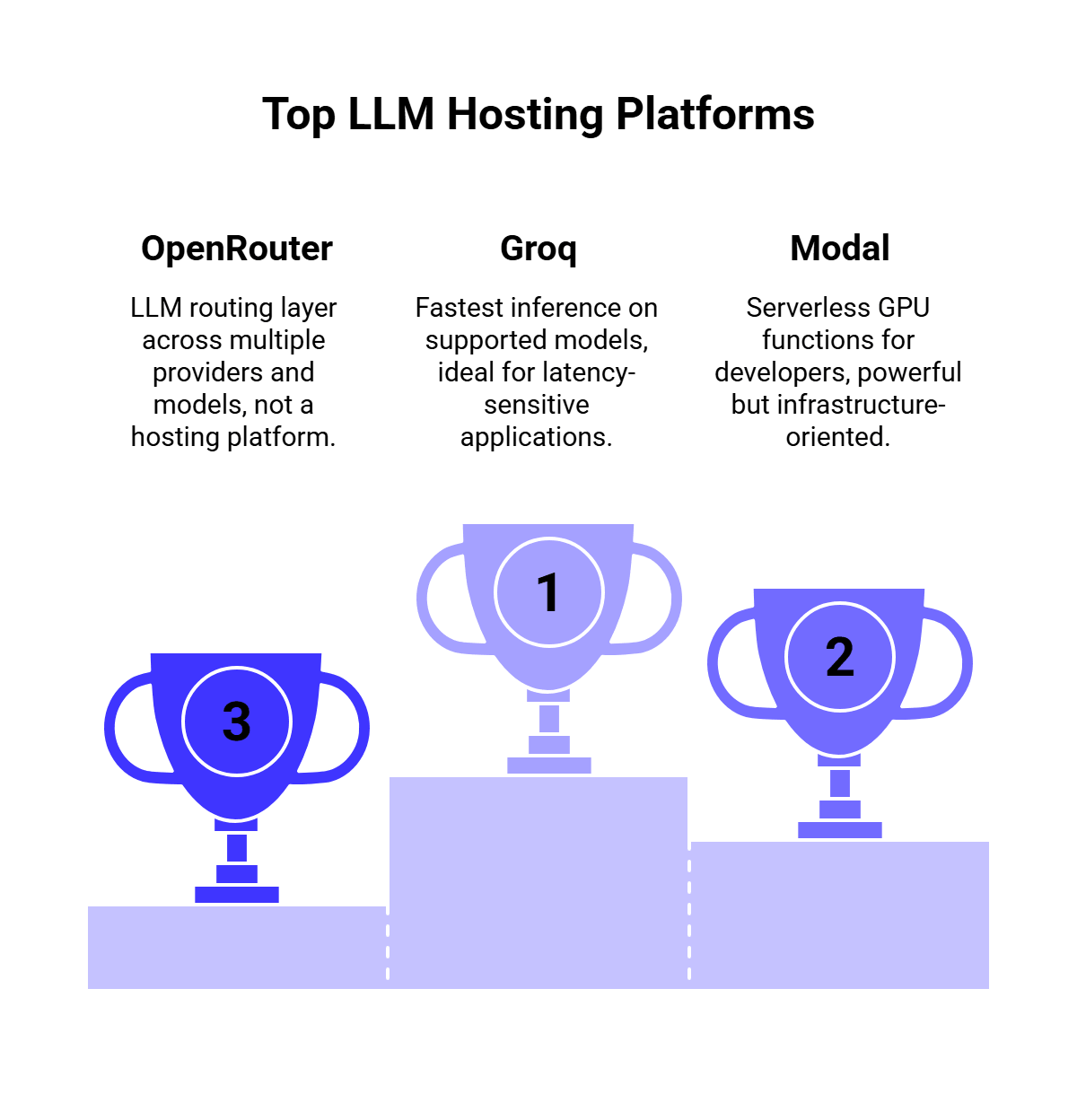
They are worth knowing, even though we did not put them in the top 6.
Groq is excellent for very fast inference on supported openly available models. Its docs list supported models, speeds, rate limits, context windows, and developer-plan limits. We would test Groq when latency is the top priority, but it is not the same as a general “host any open-source LLM” platform.
Modal is strong if your team wants serverless GPU functions and can write deployment code. Modal’s vLLM example shows how to run an OpenAI-compatible vLLM server on Modal. It is powerful, but more developer-infrastructure oriented than a simple hosted model provider.
OpenRouter is useful as an LLM routing layer across many providers and models, but it is not mainly a platform for hosting your own open-source LLM.
If your use case is routing requests across several hosted models, this is also where LLMAPI becomes relevant. Hosting providers run the models; a gateway helps manage access, routing, fallbacks, usage, and cost across providers.
The real cost question: Token API or GPU hosting?
This is the part many teams underestimate.
A token-based API is usually easier at the beginning. You pay for usage, avoid GPU management, and start quickly. Dedicated GPU hosting can be better when traffic becomes steady, but only if the GPU is used enough to justify the cost.
| Workload pattern | Better fit |
| Small prototype | Serverless token API |
| Unpredictable traffic | Serverless inference |
| Steady production traffic | Dedicated endpoint |
| Fine-tuned private model | Dedicated endpoint or custom deployment |
| Experimental model serving | RunPod, Replicate, Modal-style infra |
| Large batch jobs | Batch API or GPU infrastructure |
| Multi-provider app | Gateway layer like LLMAPI |
The 2024 paper Deploying Open-Source Large Language Models: A Performance Analysis makes a similar point from the benchmarking side. The authors tested open-source models of different sizes on available GPUs using vLLM and argued that deployment requirements are often hard to evaluate in advance. That is exactly why teams should benchmark with their own prompts, model sizes, concurrency, and latency targets before committing to a provider.
What to test before choosing a provider
Do not choose a hosting provider from pricing pages alone. Test it with your actual workload.
| Test | What to measure |
| Short chat prompts | Time to first token and cost |
| Long-context prompts | Memory behavior and latency |
| JSON output tasks | Schema reliability |
| Concurrent requests | Throughput and error rates |
| Batch jobs | Total time and discount options |
| RAG workloads | Latency with longer context |
| Fine-tuned models | Deployment and update flow |
| Traffic spikes | Autoscaling and cold-start behavior |
| Fallback routing | What happens when the provider is slow or unavailable |
For many AI apps, time-to-first-token matters as much as total response time. A model that streams quickly can feel much faster to users even if the full answer takes the same number of seconds.
Also test boring things: logs, error messages, retries, auth, usage dashboards, model versioning, and support. Those details become important the first time production breaks at 2 a.m.
Where LLMAPI fits in open-source LLM hosting
LLMAPI should not be treated as a replacement for every hosting provider in this list. A hosting provider is where the model runs. LLMAPI is more useful as the gateway layer around those models.
A typical workflow can look like this:
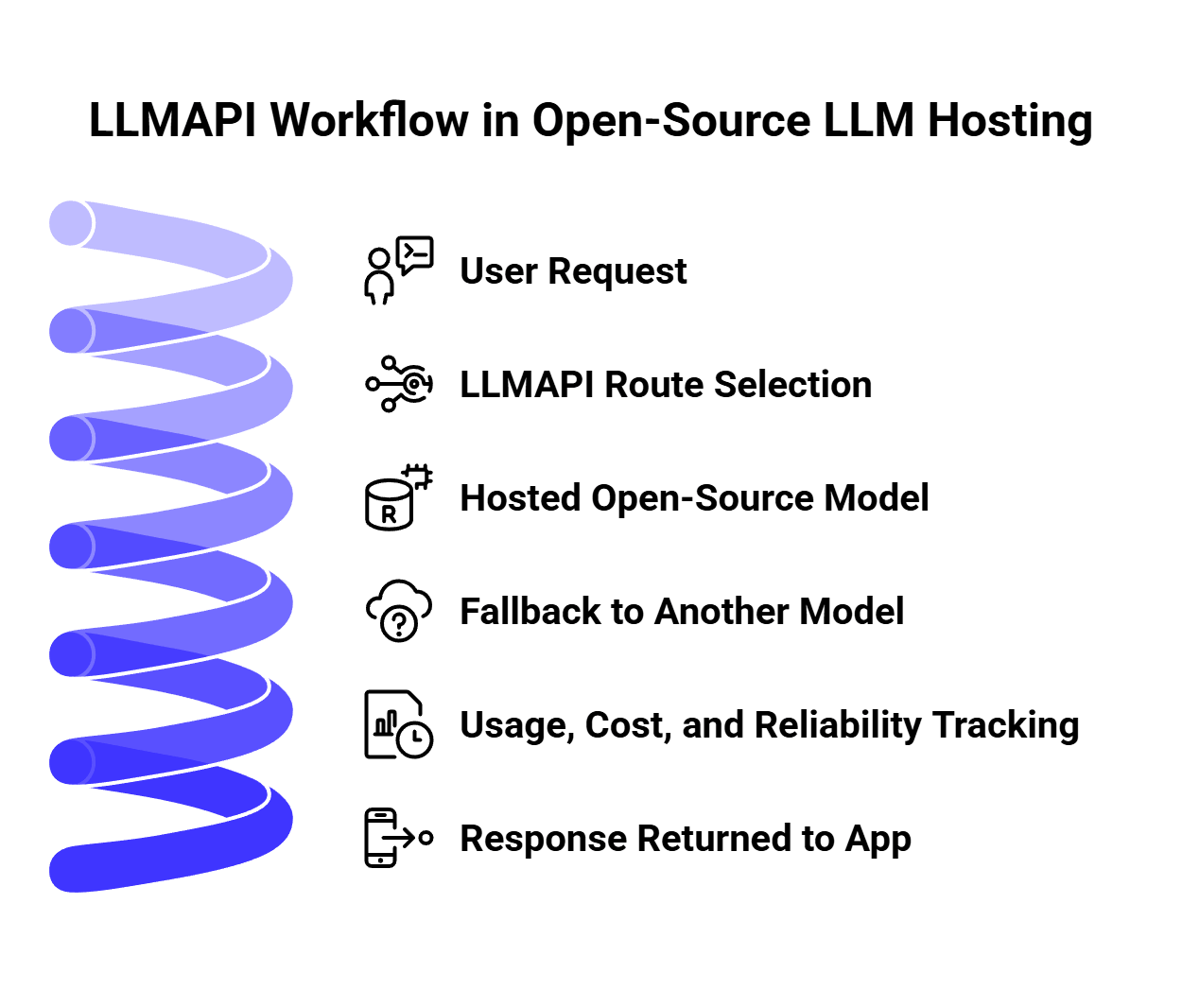
That setup helps when your app uses several models for different tasks. For example:
| Task | Possible model route |
| Cheap classification | Small open-source model |
| Customer-facing chat | Stronger hosted LLM |
| Long document summary | Long-context model |
| Code generation | Code-tuned model |
| Internal batch jobs | Lower-cost batch route |
| Fallback | Similar model on another provider |
LLMAPI’s official site describes support for 200+ models, centralized API key management, routing, cost-aware analytics, provider breakdowns, and reliability monitoring. That is useful once your app moves beyond one model and one provider.
Research on multi-provider LLM workflows points in the same direction. The paper Prompto: An Open Source Library for Querying Large Language Models notes that LLMs often sit behind different proprietary or self-hosted endpoints, and working across multiple endpoints can require custom code. A gateway layer helps reduce that integration mess.
Security and compliance checks
Open-source LLM hosting still needs serious security checks, especially if user data is involved.
Before choosing a provider, ask:
| Question | Why it matters |
| Where is the model hosted? | Region matters for compliance |
| Is the endpoint shared or dedicated? | Multi-tenant risks differ |
| Can we use private models? | Fine-tuned models may contain sensitive data |
| Are prompts and outputs logged? | Logs may contain user data |
| Can we disable training on our data? | Important for privacy |
| Who can access API keys? | Prevents accidental leakage |
| Are there audit logs? | Needed for production governance |
| Can we set spend and usage limits? | Prevents runaway cost |
Baseten’s dedicated inference page mentions single-tenant deployments, region locking, HIPAA compliance, and SOC 2 Type II certification for Baseten Cloud. That kind of information matters if the app handles regulated or sensitive workloads.
For multi-tenant SaaS apps, security risk grows when models, tools, and routing layers are shared. The 2026 paper Security Challenges of LLM Integration in Multi-Tenant SaaS identified 18 vulnerability classes and found that 12 had stronger impact in multi-tenant deployments than in single-tenant systems. If your app routes user prompts across hosted providers, tenant isolation, key management, and logging rules should be part of the design from day one.
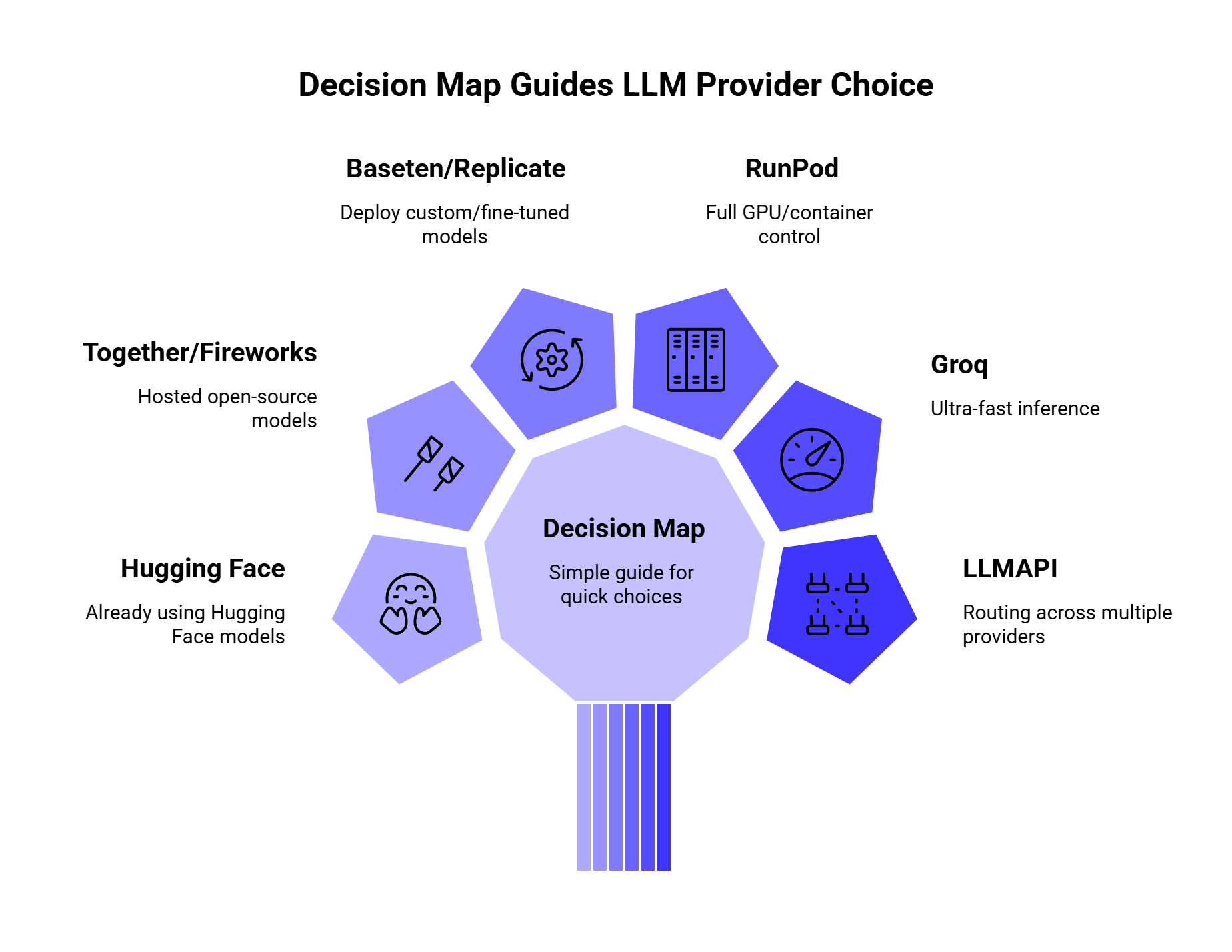
Simple decision map
Use this if you need to pick quickly:
Do you already use Hugging Face models?
→ Start with Hugging Face Inference Endpoints.
Do you want hosted open-source models with minimal setup?
→ Test Together AI and Fireworks AI.
Do you need to deploy a custom or fine-tuned model?
→ Test Baseten or Replicate.
Do you want full GPU/control and can manage containers?
→ Test RunPod.
Do you need ultra-fast inference on supported open models?
→ Also test Groq.
Do you need routing across multiple providers?
→ Add LLM API as the gateway layer.
Common use cases
AI app prototypes
Use Together AI, Fireworks AI, Replicate, or Hugging Face to test models quickly without standing up your own GPU stack.
Production chatbots
Use Together AI, Fireworks AI, Hugging Face, or Baseten depending on whether you need serverless API access, dedicated endpoints, or custom deployments.
Fine-tuned model serving
Use Baseten, Hugging Face Inference Endpoints, Replicate, or Together AI dedicated endpoints if you need to deploy fine-tuned models.
RAG applications
Use a provider that supports the context length, latency, and cost profile your RAG workload needs. Then add LLMAPI if you want routing, fallback, or provider-level observability.
Batch inference
Use Together AI batch options, dedicated endpoints, or GPU infrastructure like RunPod if the workload can wait and cost matters more than instant response.
Experimental open-source models
Use Replicate, RunPod, Hugging Face, or Modal-style deployments when you want to test models that may not be available through mainstream inference catalogs yet.
Final ranking
| Rank | Provider | Best for | Why we ranked it here |
| 1 | Together AI | Hosted open-source model inference | Strong balance of serverless, dedicated, and model access |
| 2 | Fireworks AI | Fast production LLM APIs | Strong managed inference focus |
| 3 | Hugging Face Inference Endpoints | Hugging Face-native deployments | Easiest path from HF model to managed endpoint |
| 4 | Baseten | Custom and fine-tuned production models | Strong dedicated deployment tooling |
| 5 | RunPod | GPU control and serverless infrastructure | Flexible for teams that can manage more ops |
| 6 | Replicate | Demos and custom model packaging | Fast path from model to API |
This ranking is based on general production fit, not one universal benchmark. If you already know your model, traffic pattern, and latency target, your ranking may change.
FAQs
What is the best provider for hosting open-source LLMs?
Together AI and Fireworks AI are the strongest first tests for hosted open-source LLM inference. Hugging Face Inference Endpoints is the best first choice if your model already lives on Hugging Face. Baseten is stronger for custom production deployments, while RunPod is better for teams that want more GPU control.
Can I host my own fine-tuned open-source LLM?
Yes. Hugging Face Inference Endpoints, Baseten, Together AI dedicated endpoints, Replicate, and RunPod can all support custom or fine-tuned model workflows in different ways. The best option depends on how much control you need and how much infrastructure your team wants to manage.
Is serverless inference cheaper than dedicated hosting?
Sometimes. Serverless is usually cheaper for low or unpredictable traffic because you do not pay for idle GPUs. Dedicated hosting can become cheaper when traffic is steady and high enough to keep the GPU busy.
Which provider is best for prototypes?
Replicate, Together AI, Fireworks AI, and Hugging Face are good prototype choices. Replicate is especially friendly for demos and custom model packaging. Together and Fireworks are better when you want to test popular open-source chat models through hosted APIs.
Which provider gives the most control?
RunPod gives the most infrastructure control in this list. You can choose GPU types, run custom containers, deploy vLLM, and manage the serving stack more directly. The tradeoff is more DevOps responsibility.
Where does LLMAPI fit?
LLMAPI fits above the hosting layer. It can help route requests across models and providers, manage keys, monitor usage, compare costs, and add fallback logic. The hosting provider runs the model; LLM API helps manage how your app uses models across providers.
Final thoughts
Open-source LLM hosting is not only about finding a GPU. The real decision is how much control, speed, cost predictability, and operational work your team wants to take on.
Choose Together AI or Fireworks AI if you want hosted open-source models with minimal infrastructure work. Choose Hugging Face Inference Endpoints if your workflow already starts on the Hugging Face Hub. Choose Baseten for custom and fine-tuned production deployments. Choose RunPod if your team wants GPU flexibility and can manage the serving stack. Choose Replicate if you want quick demos, public model APIs, or simple custom model packaging.
Once your app uses more than one hosted model, add a gateway layer. LLMAPI can help teams route requests, monitor usage, manage API keys, compare providers, and build more stable AI workflows without hardcoding every model integration separately.
The best setup is the one that matches your traffic. Test with your real prompts, real context lengths, real concurrency, and real budget. A provider that looks cheap in a tiny demo can get expensive in production, and a provider that looks heavy at first can save a lot of engineering time once the app grows.
Want to compare the models behind this? Check live pricing and specs for DeepSeek R1 0528, Llama 3.1 70B Instruct Deployment Guide & API Specs and DeepSeek V3 0324. To keep usage predictable as you scale, see our guide to AI cost management.